


Page 174 - Computer Graphics Handout
P. 174
Finally, the far plane z =−far is transformed to the plane


          If we select


          then the plane z =−near is mapped to the plane z__ =−1, the plane z =−far is mapped to the plane z__ = 1, and we have our canonical
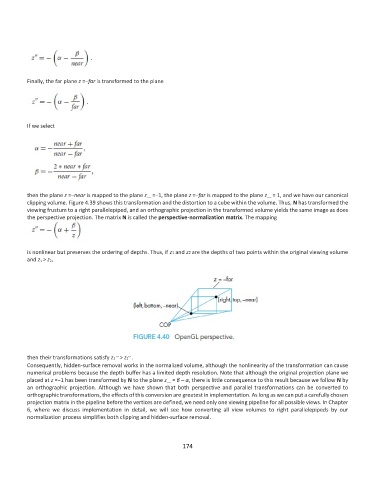
          clipping volume. Figure 4.39 shows this transformation and the distortion to a cube within the volume. Thus, N has transformed the
          viewing frustum to a right parallelepiped, and an orthographic projection in the transformed volume yields the same image as does
          the perspective projection. The matrix N is called the perspective-normalization matrix. The mapping


          is nonlinear but preserves the ordering of depths. Thus, if z1 and z2 are the depths of two points within the original viewing volume
          and z 1 > z 2,


                                        ,,  ,,
          then their transformations satisfy z1   > z 2  .
          Consequently, hidden-surface removal works in the normalized volume, although the nonlinearity of the transformation can cause
          numerical problems because the depth buffer has a limited depth resolution. Note that although the original projection plane we
          placed at z =−1 has been transformed by N to the plane z__ = β – α, there is little consequence to this result because we follow N by
          an orthographic projection. Although we have shown that both  perspective and parallel transformations can be  converted to
          orthographic transformations, the effects of this conversion are greatest in implementation. As long as we can put a carefully chosen
          projection matrix in the pipeline before the vertices are defined, we need only one viewing pipeline for all possible views. In Chapter
          6,  where  we  discuss  implementation  in  detail,  we  will  see  how  converting  all  view  volumes  to  right  parallelepipeds  by  our
          normalization process simplifies both clipping and hidden-surface removal.


                                                             174

