


Page 73 - Computer Graphics Handout
P. 73
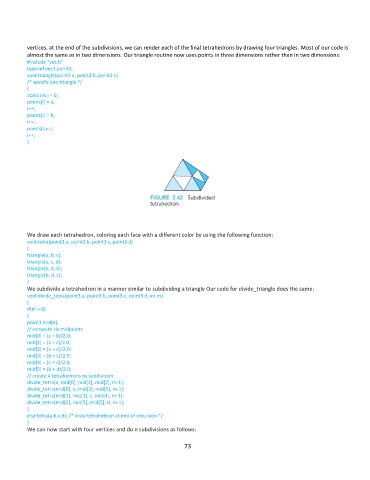
vertices, at the end of the subdivisions, we can render each of the final tetrahedrons by drawing four triangles. Most of our code is
          almost the same as in two dimensions. Our triangle routine now uses points in three dimensions rather than in two dimensions:
          #include "vec.h"
          typedef vec3 point3;
          void triangle(point3 a, point3 b, point3 c)
          /* specify one triangle */
          {
          static int i = 0;
          points[i] = a;
          i++;
          points[i] = b;
          i++;
          points[i]= c;
          i++;
          }


          We draw each tetrahedron, coloring each face with a different color by using the following function:
          void tetra(point3 a, point3 b, point3 c, point3 d)
          {
          triangle(a, b, c);
          triangle(a, c, d);
          triangle(a, d, b);
          triangle(b, d, c);
          }
          We subdivide a tetrahedron in a manner similar to subdividing a triangle Our code for divide_triangle does the same:
          void divide_tetra(point3 a, point3 b, point3 c, point3 d, int m)
          {
          if(m > 0)
          {
          point3 mid[6];
          // compute six midpoints
          mid[0] = (a + b)/2.0;
          mid[1] = (a + c)/2.0;
          mid[2] = (a + d)/2.0;
          mid[3] = (b + c)/2.0;
          mid[4] = (c + d)/2.0;
          mid[5] = (b + d)/2.0;
          // create 4 tetrahedrons by subdivision
          divide_tetra(a, mid[0], mid[1], mid[2], m-1);
          divide_tetra(mid[0], b, mid[3], mid[5], m-1);
          divide_tetra(mid[1], mid[3], c, mid[4], m-1);
          divide_tetra(mid[2], mid[5], mid[5], d, m-1);
          }
          else tetra(a,b,c,d); /* draw tetrahedron at end of recursion */
          }
          We can now start with four vertices and do n subdivisions as follows:

                                                              73

