


Page 69 - Computer Graphics Handout
P. 69
2.9 POLYGONS AND RECURSION


          The output from our gasket program (Figure 2.2) shows considerable structure. If we were to run
          the program with more iterations, then much of the randomness inthe image would disappear.
          Examining this structure, we see that regardless of how many points we generate, there are no
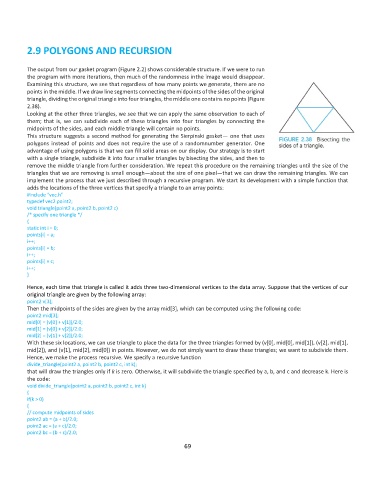
          points in the middle. If we draw line segments connecting the midpoints of the sides of the original
          triangle, dividing the original triangle into four triangles, the middle one contains no points (Figure
          2.38).
          Looking at the other three triangles, we see that we can apply the same observation to each of
          them; that is, we can subdivide each of these triangles into four triangles by connecting the
          midpoints of the sides, and each middle triangle will contain no points.
          This structure suggests a second method for generating the Sierpinski gasket— one that uses
          polygons instead of points and does not require the use of a randomnumber generator. One
          advantage of using polygons is that we can fill solid areas on our display. Our strategy is to start
          with a single triangle, subdivide it into four smaller triangles by bisecting the sides, and then to
          remove the middle triangle from further consideration. We repeat this procedure on the remaining triangles until the size of the
          triangles that we are removing is small enough—about the size of one pixel—that we can draw the remaining triangles. We can
          implement the process that we just described through a recursive program. We start its development with a simple function that
          adds the locations of the three vertices that specify a triangle to an array points:
          #include "vec.h"
          typedef vec2 point2;
          void triangle(point2 a, point2 b, point2 c)
          /* specify one triangle */
          {
          static int i = 0;
          points[i] = a;
          i++;
          points[i] = b;
          i++;
          points[i] = c;
          i++;
          }

          Hence, each time that triangle is called it adds three two-dimensional vertices to the data array. Suppose that the vertices of our
          original triangle are given by the following array:
          point2 v[3];
          Then the midpoints of the sides are given by the array mid[3], which can be computed using the following code:
          point2 mid[3];
          mid[0] = (v[0] + v[1])/2.0;
          mid[1] = (v[0] + v[2])/2.0;
          mid[2] = (v[1] + v[2])/2.0;
          With these six locations, we can use triangle to place the data for the three triangles formed by (v[0], mid[0], mid[1]), (v[2], mid[1],
          mid[2]), and (v[1], mid[2], mid[0]) in points. However, we do not simply want to draw these triangles; we want to subdivide them.
          Hence, we make the process recursive. We specify a recursive function
          divide_triangle(point2 a, point2 b, point2 c, int k);
          that will draw the triangles only if k is zero. Otherwise, it will subdivide the triangle specified by a, b, and c and decrease k. Here is
          the code:
          void divide_triangle(point2 a, point2 b, point2 c, int k)
          {
          if(k > 0)
          {
          // compute midpoints of sides
          point2 ab = (a + b)/2.0;
          point2 ac = (a + c)/2.0;
          point2 bc = (b + c)/2.0;
                                                              69

