


Page 105 - Handout of Computer Architecture (1)..
P. 105
■ They are capable of being read to sense the state.

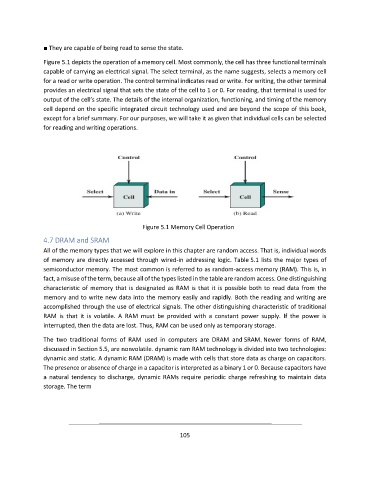
               Figure 5.1 depicts the operation of a memory cell. Most commonly, the cell has three functional terminals
               capable of carrying an electrical signal. The select terminal, as the name suggests, selects a memory cell
               for a read or write operation. The control terminal indicates read or write. For writing, the other terminal
               provides an electrical signal that sets the state of the cell to 1 or 0. For reading, that terminal is used for
               output of the cell’s state. The details of the internal organization, functioning, and timing of the memory
               cell depend on the specific integrated circuit technology used and are beyond the scope of this book,
               except for a brief summary. For our purposes, we will take it as given that individual cells can be selected
               for reading and writing operations.


                                                Figure 5.1 Memory Cell Operation

               4.7 DRAM and SRAM
               All of the memory types that we will explore in this chapter are random access. That is, individual words
               of memory are directly accessed through wired-in addressing logic. Table 5.1 lists the major types of
               semiconductor memory. The most common is referred to as random-access memory (RAM). This is, in
               fact, a misuse of the term, because all of the types listed in the table are random access. One distinguishing
               characteristic of memory that is designated as RAM is that it is possible both to read data from  the
               memory and to write new data into the memory easily and rapidly. Both the reading and writing are
               accomplished through the use of electrical signals. The other distinguishing characteristic of traditional
               RAM  is  that  it  is  volatile.  A  RAM  must  be  provided  with  a  constant  power  supply.  If  the  power  is
               interrupted, then the data are lost. Thus, RAM can be used only as temporary storage.

               The  two  traditional  forms  of  RAM  used  in  computers  are  DRAM  and SRAM. Newer  forms  of  RAM,
               discussed in Section 5.5, are nonvolatile. dynamic ram RAM technology is divided into two technologies:
               dynamic and static. A dynamic RAM (DRAM) is made with cells that store data as charge on capacitors.
               The presence or absence of charge in a capacitor is interpreted as a binary 1 or 0. Because capacitors have
               a  natural  tendency  to  discharge,  dynamic  RAMs  require  periodic  charge  refreshing  to  maintain  data
               storage. The term


                                                             105

