


Page 107 - Handout of Computer Architecture (1)..
P. 107
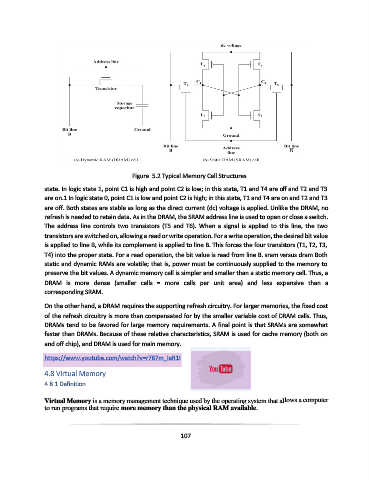
Figure  5.2 Typical Memory Cell Structures
               state. In logic state 1, point C1 is high and point C2 is low; in this state, T1 and T4 are off and T2 and T3
               are on.1 In logic state 0, point C1 is low and point C2 is high; in this state, T1 and T4 are on and T2 and T3
               are off. Both states are stable as long as the direct current (dc) voltage is applied. Unlike the DRAM, no
               refresh is needed to retain data. As in the DRAM, the SRAM address line is used to open or close a switch.
               The  address  line  controls  two  transistors  (T5  and  T6).  When  a  signal  is  applied  to  this  line,  the  two
               transistors are switched on, allowing a read or write operation. For a write operation, the desired bit value
               is applied to line B, while its complement is applied to line B. This forces the four transistors (T1, T2, T3,
               T4) into the proper state. For a read operation, the bit value is read from line B. sram versus dram Both
               static and dynamic RAMs are volatile; that is, power must be continuously supplied to the memory to
               preserve the bit values. A dynamic memory cell is simpler and smaller than a static memory cell. Thus, a
               DRAM  is  more  dense  (smaller  cells  =  more  cells  per  unit  area)  and  less  expensive  than  a
               corresponding SRAM.

               On the other hand, a DRAM requires the supporting refresh circuitry. For larger memories, the fixed cost
               of the refresh circuitry is more than compensated for by the smaller variable cost of DRAM cells. Thus,
               DRAMs tend to be favored for large memory requirements. A final point is that SRAMs are somewhat
               faster than DRAMs. Because of these relative characteristics, SRAM is used for cache memory (both on
               and off chip), and DRAM is used for main memory.

               https://www.youtube.com/watch?v=r787m_IaR1I

               4.8 Virtual Memory
               4.8.1 Definition


               Virtual Memory is a memory management technique used by the operating system that allows a computer
               to run programs that require more memory than the physical RAM available.


                                                             107

