


Page 112 - Handout of Computer Architecture (1)..
P. 112
5.2 Keyboard/Monitor
               The most common means of computer/user interaction is a keyboard/monitor arrangement. The user
               provides input through the keyboard, the input is then trans mitted to the computer and may also be
               displayed on the monitor. In addition, the monitor displays data provided by the computer.


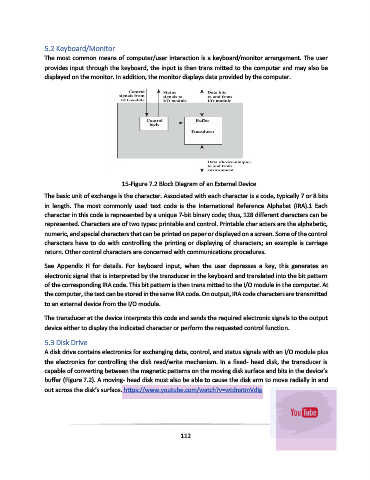
                                         15-Figure 7.2 Block Diagram of an External Device

               The basic unit of exchange is the character. Associated with each character is a code, typically 7 or 8 bits
               in  length.  The  most  commonly  used  text  code  is  the  International  Reference  Alphabet  (IRA).1  Each
               character in this code is represented by a unique 7-bit binary code; thus, 128 different characters can be
               represented. Characters are of two types: printable and control. Printable char acters are the alphabetic,
               numeric, and special characters that can be printed on paper or displayed on a screen. Some of the control
               characters have to do with controlling the printing or displaying of characters; an example is carriage
               return. Other control characters are concerned with communications procedures.

               See  Appendix  H  for  details.  For  keyboard  input,  when  the  user  depresses  a  key,  this  generates  an
               electronic signal that is interpreted by the transducer in the keyboard and translated into the bit pattern
               of the corresponding IRA code. This bit pattern is then trans mitted to the I/O module in the computer. At
               the computer, the text can be stored in the same IRA code. On output, IRA code characters are transmitted
               to an external device from the I/O module.

               The transducer at the device interprets this code and sends the required electronic signals to the output
               device either to display the indicated character or perform the requested control function.

               5.3 Disk Drive
               A disk drive contains electronics for exchanging data, control, and status signals with an I/O module plus
               the electronics for controlling the disk read/write mechanism. In a fixed- head disk, the transducer is
               capable of converting between the magnetic patterns on the moving disk surface and bits in the device’s
               buffer (Figure 7.2). A moving- head disk must also be able to cause the disk arm to move radially in and
               out across the disk’s surface. https://www.youtube.com/watch?v=wtdnatmVdIg


                                                             112

