


Page 116 - Handout of Computer Architecture (1)..
P. 116
task of I/O and can move data at a rather high rate, at the cost of doing nothing else. Interrupt I/O frees
               up the processor to some extent at the expense of the I/O transfer rate. Nevertheless, both methods have
               an adverse impact on both processor activity and I/O transfer rate. When large volumes of data are to be
               moved, a more efficient technique is required: direct memory access (DMA).

               https://www.youtube.com/watch?v=trO6gWz5l2k

               5.7 DMA Function
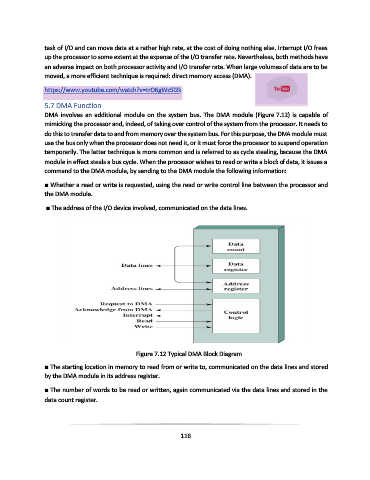
               DMA  involves  an  additional  module  on  the  system bus.  The  DMA module  (Figure 7.12)  is  capable  of
               mimicking the processor and, indeed, of taking over control of the system from the processor. It needs to
               do this to transfer data to and from memory over the system bus. For this purpose, the DMA module must
               use the bus only when the processor does not need it, or it must force the processor to suspend operation
               temporarily. The latter technique is more common and is referred to as cycle stealing, because the DMA
               module in effect steals a bus cycle. When the processor wishes to read or write a block of data, it issues a
               command to the DMA module, by sending to the DMA module the following information:

               ■ Whether a read or write is requested, using the read or write control line between the processor and
               the DMA module.
                ■ The address of the I/O device involved, communicated on the data lines.


                                              Figure 7.12 Typical DMA Block Diagram

               ■ The starting location in memory to read from or write to, communicated on the data lines and stored
               by the DMA module in its address register.

               ■ The number of words to be read or written, again communicated via the data lines and stored in the
               data count register.


                                                             116

