


Page 117 - Handout of Computer Architecture (1)..
P. 117
The processor then continues with other work. It has delegated this I/O operation to the DMA module.
               The DMA module transfers the entire block of data, one word at a time, directly to or from memory,
               without going through the processor. When the transfer is complete, the DMA module sends an interrupt
               signal to the processor. Thus, the processor is involved only at the beginning and end of the transfer
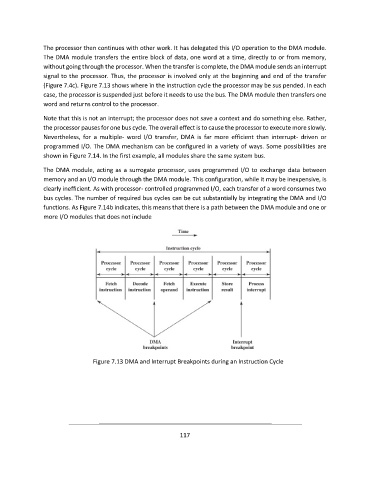
               (Figure 7.4c). Figure 7.13 shows where in the instruction cycle the processor may be sus pended. In each
               case, the processor is suspended just before it needs to use the bus. The DMA module then transfers one
               word and returns control to the processor.

               Note that this is not an interrupt; the processor does not save a context and do something else. Rather,
               the processor pauses for one bus cycle. The overall effect is to cause the processor to execute more slowly.
               Nevertheless,  for  a  multiple-  word  I/O  transfer,  DMA  is  far  more  efficient  than  interrupt-  driven  or
               programmed I/O. The DMA mechanism can be configured in a variety of ways. Some possibilities are
               shown in Figure 7.14. In the first example, all modules share the same system bus.
               The DMA module, acting as a surrogate processor, uses programmed I/O to exchange data between
               memory and an I/O module through the DMA module. This configuration, while it may be inexpensive, is
               clearly inefficient. As with processor- controlled programmed I/O, each transfer of a word consumes two
               bus cycles. The number of required bus cycles can be cut substantially by integrating the DMA and I/O
               functions. As Figure 7.14b indicates, this means that there is a path between the DMA module and one or
               more I/O modules that does not include


                                Figure 7.13 DMA and Interrupt Breakpoints during an Instruction Cycle


                                                             117

