


Page 115 - Handout of Computer Architecture (1)..
P. 115
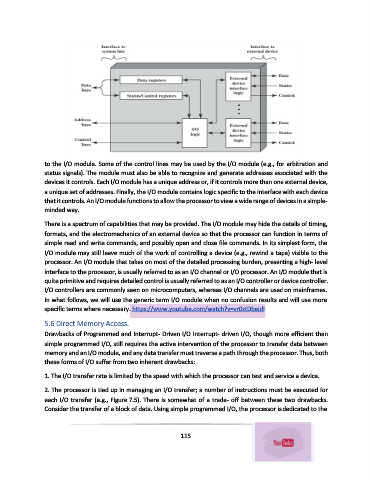
to the I/O module. Some of the control lines may be used by the I/O module (e.g., for arbitration and
               status signals). The module must also be able to recognize and generate addresses associated with the
               devices it controls. Each I/O module has a unique address or, if it controls more than one external device,
               a unique set of addresses. Finally, the I/O module contains logic specific to the interface with each device
               that it controls. An I/O module functions to allow the processor to view a wide range of devices in a simple-
               minded way.

               There is a spectrum of capabilities that may be provided. The I/O module may hide the details of timing,
               formats, and the electromechanics of an external device so that the processor can function in terms of
               simple read and write commands, and possibly open and close file commands. In its simplest form, the
               I/O module may still leave much of the work of controlling a device (e.g., rewind a tape) visible to the
               processor. An I/O module that takes on most of the detailed processing burden, presenting a high- level
               interface to the processor, is usually referred to as an I/O channel or I/O processor. An I/O module that is
               quite primitive and requires detailed control is usually referred to as an I/O controller or device controller.
               I/O controllers are commonly seen on microcomputers, whereas I/O channels are used on mainframes.
               In what follows, we will use the generic term I/O module when no confusion results and will use more
               specific terms where necessary. https://www.youtube.com/watch?v=vr0ztDbejdI

               5.6 Direct Memory Access.
               Drawbacks of Programmed and Interrupt- Driven I/O Interrupt- driven I/O, though more efficient than
               simple programmed I/O, still requires the active intervention of the processor to transfer data between
               memory and an I/O module, and any data transfer must traverse a path through the processor. Thus, both
               these forms of I/O suffer from two inherent drawbacks:

               1. The I/O transfer rate is limited by the speed with which the processor can test and service a device.

               2. The processor is tied up in managing an I/O transfer; a number of instructions must be executed for
               each I/O transfer (e.g., Figure 7.5). There is somewhat of a trade- off between these two drawbacks.
               Consider the transfer of a block of data. Using simple programmed I/O, the processor is dedicated to the


                                                             115

