


Page 191 - Handout of Computer Architecture (1)..
P. 191
■ ALU: The control unit controls the operation of the ALU by a set of control signals. These signals activate
               various logic circuits and gates within the ALU.

               ■ System bus: The control unit sends control signals out onto the control lines of the system bus (e.g.,
               memory READ). The control unit must maintain knowledge of where it is in the instruction cycle. Using
               this knowledge, and by reading all of its inputs, the control unit emits a sequence of control signals that
               causes micro- operations to occur. It uses the clock pulses to time the sequence of events, allowing time
               between events for signal levels to stabilize.

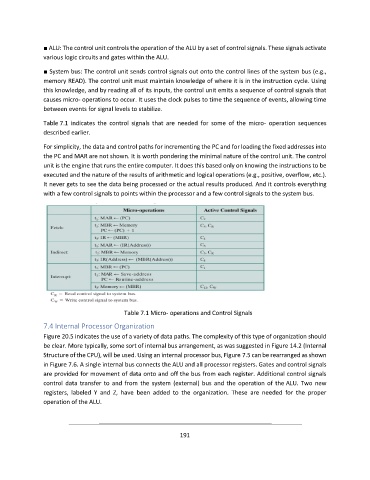
               Table 7.1  indicates  the  control  signals  that  are  needed  for  some  of  the  micro-  operation  sequences
               described earlier.

               For simplicity, the data and control paths for incrementing the PC and for loading the fixed addresses into
               the PC and MAR are not shown. It is worth pondering the minimal nature of the control unit. The control
               unit is the engine that runs the entire computer. It does this based only on knowing the instructions to be
               executed and the nature of the results of arithmetic and logical operations (e.g., positive, overflow, etc.).
               It never gets to see the data being processed or the actual results produced. And it controls everything
               with a few control signals to points within the processor and a few control signals to the system bus.


                                          Table 7.1 Micro- operations and Control Signals
               7.4 Internal Processor Organization

               Figure 20.5 indicates the use of a variety of data paths. The complexity of this type of organization should
               be clear. More typically, some sort of internal bus arrangement, as was suggested in Figure 14.2 (Internal
               Structure of the CPU), will be used. Using an internal processor bus, Figure 7.5 can be rearranged as shown
               in Figure 7.6. A single internal bus connects the ALU and all processor registers. Gates and control signals
               are provided for movement of data onto and off the bus from each register. Additional control signals
               control data transfer to and from the system (external) bus and the operation of the ALU. Two new
               registers,  labeled  Y  and  Z,  have  been  added  to  the  organization.  These  are  needed  for  the  proper
               operation of the ALU.


                                                             191

