


Page 189 - Handout of Computer Architecture (1)..
P. 189
We defer a discussion of the internal operation of the control unit to Section .3. The remainder of this
               section  is  concerned  with  the  interaction  between  the  control  unit  and  the  other  elements  of  the
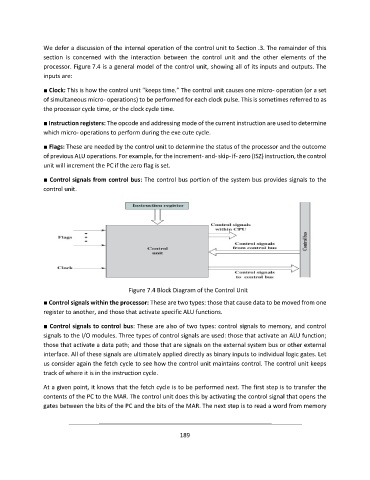
               processor. Figure 7.4 is a general model of the control unit, showing all of its inputs and outputs. The
               inputs are:

               ■ Clock: This is how the control unit “keeps time.” The control unit causes one micro- operation (or a set
               of simultaneous micro- operations) to be performed for each clock pulse. This is sometimes referred to as
               the processor cycle time, or the clock cycle time.

               ■ Instruction registers: The opcode and addressing mode of the current instruction are used to determine
               which micro- operations to perform during the exe cute cycle.

               ■ Flags: These are needed by the control unit to determine the status of the processor and the outcome
               of previous ALU operations. For example, for the increment- and- skip- if- zero (ISZ) instruction, the control
               unit will increment the PC if the zero flag is set.
               ■ Control signals from control bus: The control bus portion of the system bus provides signals to the
               control unit.


                                            Figure 7.4 Block Diagram of the Control Unit

               ■ Control signals within the processor: These are two types: those that cause data to be moved from one
               register to another, and those that activate specific ALU functions.

               ■ Control signals to control bus: These are also of two types: control signals to memory, and control
               signals to the I/O modules. Three types of control signals are used: those that activate an ALU function;
               those that activate a data path; and those that are signals on the external system bus or other external
               interface. All of these signals are ultimately applied directly as binary inputs to individual logic gates. Let
               us consider again the fetch cycle to see how the control unit maintains control. The control unit keeps
               track of where it is in the instruction cycle.

               At a given point, it knows that the fetch cycle is to be performed next. The first step is to transfer the
               contents of the PC to the MAR. The control unit does this by activating the control signal that opens the
               gates between the bits of the PC and the bits of the MAR. The next step is to read a word from memory


                                                             189

