


Page 185 - Handout of Computer Architecture (1)..
P. 185
The IR is now in the same state as if indirect addressing had not been used, and it is ready for the execute
               cycle. We skip that cycle for a moment, to consider the interrupt cycle.

               The Interrupt Cycle At the completion of the execute cycle, a test is made to determine whether any
               enabled interrupts have occurred. If so, the interrupt cycle occurs. The nature of this cycle varies greatly
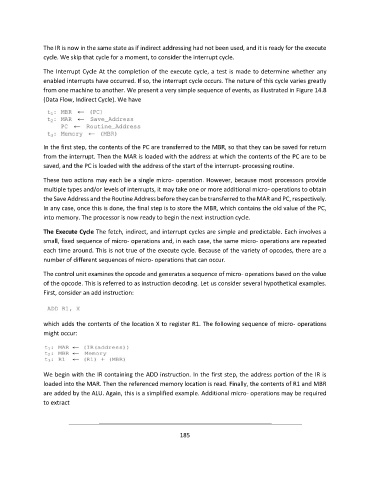
               from one machine to another. We present a very simple sequence of events, as illustrated in Figure 14.8
               (Data Flow, Indirect Cycle). We have


               In the first step, the contents of the PC are transferred to the MBR, so that they can be saved for return
               from the interrupt. Then the MAR is loaded with the address at which the contents of the PC are to be
               saved, and the PC is loaded with the address of the start of the interrupt- processing routine.
               These two actions may each be a single micro- operation. However, because most processors provide
               multiple types and/or levels of interrupts, it may take one or more additional micro- operations to obtain
               the Save Address and the Routine Address before they can be transferred to the MAR and PC, respectively.
               In any case, once this is done, the final step is to store the MBR, which contains the old value of the PC,
               into memory. The processor is now ready to begin the next instruction cycle.

               The Execute Cycle The fetch, indirect, and interrupt cycles are simple and predictable. Each involves a
               small, fixed sequence of micro- operations and, in each case, the same micro- operations are repeated
               each time around. This is not true of the execute cycle. Because of the variety of opcodes, there are a
               number of different sequences of micro- operations that can occur.

               The control unit examines the opcode and generates a sequence of micro- operations based on the value
               of the opcode. This is referred to as instruction decoding. Let us consider several hypothetical examples.
               First, consider an add instruction:


               which adds the contents of the location X to register R1. The following sequence of micro- operations
               might occur:


               We begin with the IR containing the ADD instruction. In the first step, the address portion of the IR is
               loaded into the MAR. Then the referenced memory location is read. Finally, the contents of R1 and MBR
               are added by the ALU. Again, this is a simplified example. Additional micro- operations may be required
               to extract


                                                             185

