


Page 184 - Handout of Computer Architecture (1)..
P. 184
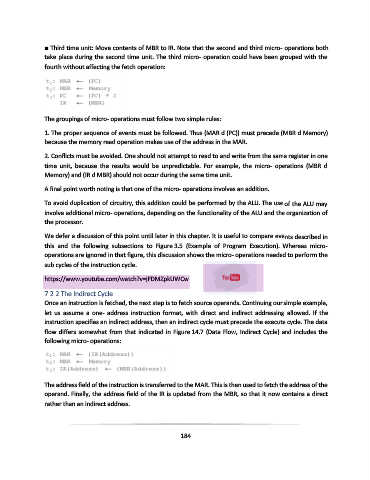
■ Third time unit: Move contents of MBR to IR. Note that the second and third micro- operations both
               take place during the second time unit. The third micro- operation could have been grouped with the
               fourth without affecting the fetch operation:


               The groupings of micro- operations must follow two simple rules:

               1. The proper sequence of events must be followed. Thus (MAR d (PC)) must precede (MBR d Memory)
               because the memory read operation makes use of the address in the MAR.

               2. Conflicts must be avoided. One should not attempt to read to and write from the same register in one
               time  unit,  because  the  results  would  be  unpredictable.  For  example,  the  micro-  operations  (MBR  d
               Memory) and (IR d MBR) should not occur during the same time unit.
               A final point worth noting is that one of the micro- operations involves an addition.

               To avoid duplication of circuitry, this addition could be performed by the ALU. The use of the ALU may
               involve additional micro- operations, depending on the functionality of the ALU and the organization of
               the processor.

               We defer a discussion of this point until later in this chapter. It is useful to compare events described in
               this  and  the  following  subsections  to  Figure 3.5  (Example  of  Program  Execution).  Whereas  micro-
               operations are ignored in that figure, this discussion shows the micro- operations needed to perform the
               sub cycles of the instruction cycle.

               https://www.youtube.com/watch?v=jFDMZpkUWCw

               7.2.2 The Indirect Cycle
               Once an instruction is fetched, the next step is to fetch source operands. Continuing our simple example,
               let  us  assume  a  one-  address  instruction  format,  with  direct  and  indirect  addressing  allowed.  If  the
               instruction specifies an indirect address, then an indirect cycle must precede the execute cycle. The data
               flow differs somewhat from that indicated in Figure 14.7 (Data Flow, Indirect Cycle) and includes the
               following micro- operations:


               The address field of the instruction is transferred to the MAR. This is then used to fetch the address of the
               operand. Finally, the address field of the IR is updated from the MBR, so that it now contains a direct
               rather than an indirect address.


                                                             184

