


Page 94 - SAPEM-Chapter-10-2nd-edition-2014
P. 94
South African Pavement Engineering Manual
                                              Chapter 10:  Pavement Design


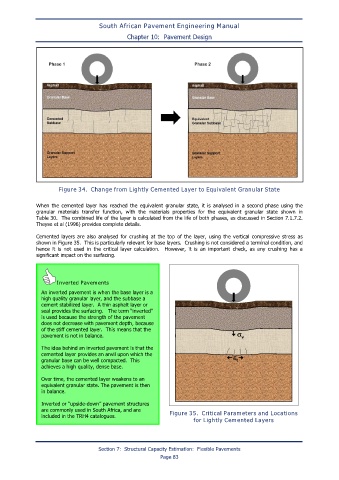
                      Figure 34.  Change from Lightly Cemented Layer to Equivalent Granular State

              When  the  cemented  layer  has  reached  the  equivalent  granular  state,  it  is  analysed  in  a  second  phase  using  the
              granular  materials  transfer  function,  with  the  materials  properties  for  the  equivalent  granular  state  shown  in
              Table 30.  The combined life of the layer is calculated from the life of both phases, as discussed in Section 7.1.7.2.
              Theyse et al (1996) provides complete details.

              Cemented  layers  are  also  analysed  for  crushing  at  the  top  of  the  layer,  using  the  vertical  compressive  stress  as
              shown in Figure 35.  This is particularly relevant for base layers.  Crushing is not considered a terminal condition, and
              hence it is not used in the critical layer calculation.  However, it is an important check, as any crushing has a
              significant impact on the surfacing.


                     Inverted Pavements
                An inverted pavement is when the base layer is a
                high quality granular layer, and the subbase a
                cement stabilized layer.  A thin asphalt layer or
                seal provides the surfacing.   The term “inverted”
                is used because the strength of the pavement
                does not decrease with pavement depth, because
                of the stiff cemented layer.  This means that the
                pavement is not in balance.                                          σ v

                The idea behind an inverted pavement is that the
                cemented layer provides an anvil upon which the                    ε
                granular base can be well compacted.  This                          t
                achieves a high quality, dense base.

                Over time, the cemented layer weakens to an
                equivalent granular state. The pavement is then
                in balance.

                Inverted or “upside-down” pavement structures
                are commonly used in South Africa, and are
                included in the TRH4 catalogues.             Figure 35.  Critical Parameters and Locations
                                                                     for Lightly Cemented Layers


                                    Section 7:  Structural Capacity Estimation:  Flexible Pavements
                                                         Page 83

