


Page 93 - SAPEM-Chapter-10-2nd-edition-2014
P. 93
South African Pavement Engineering Manual
                                              Chapter 10:  Pavement Design


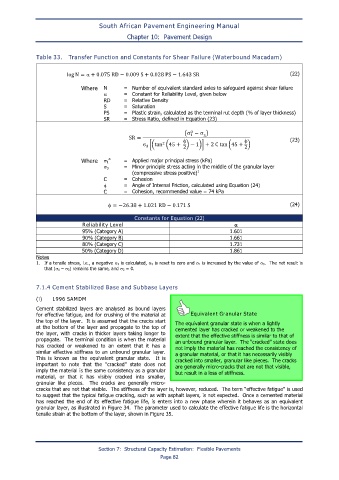
              Table 33.  Transfer Function and Constants for Shear Failure (Waterbound Macadam)

                        log N = α + 0.075 RD − 0.009 S + 0.028 PS − 1.643 SR                           (22)

                                             =  Number of equivalent standard axles to safeguard against shear failure
                              Where  N
                                     α       =  Constant for Reliability Level, given below
                                     RD      =  Relative Density
                                     S       =  Saturation
                                     PS      =  Plastic strain, calculated as the terminal rut depth (% of layer thickness)
                                     SR      =  Stress Ratio, defined in Equation (23)

                                                                  �σ − σ �

                                              SR =               φ  1   3              φ               (23)
                                                          2
                                                   σ ��tan �45 +  � − 1�� + 2 C tan �45 + �
                                                    3
                                                                 2                     2

                                       a
                              Where  σ 1     =  Applied major principal stress (kPa)
                                     σ 3     =  Minor principle stress acting in the middle of the granular layer
                                                                      1
                                                (compressive stress positive)
                                     C       =  Cohesion
                                     φ       =  Angle of Internal Friction, calculated using Equation (24)
                                     C       =  Cohesion, recommended value = 74 kPa

                                       φ = −26.38 + 1.021 RD − 0.171 S                                 (24)

                                                Constants for Equation (22)
                              Reliability Level                                    α
                              95% (Category A)                                    1.601
                              90% (Category B)                                    1.661
                              80% (Category C)                                    1.731
                              50% (Category D)                                    1.861
              Notes
              1.  If a tensile stress, i.e., a negative σ 3 is calculated, σ 3 is reset to zero and σ 1 is increased by the value of σ 3.  The net result is
                 that (σ 1 – σ 3) remains the same, and σ 3 = 0.


              7.1.4 Cement Stabilized Base and Subbase Layers

              (i)   1996 SAMDM
              Cement  stabilized  layers  are  analysed  as  bound  layers
              for effective fatigue, and for crushing of the material at   Equivalent Granular State
              the top of the layer.  It is assumed that the cracks start   The equivalent granular state is when a lightly
              at the bottom of the layer and propagate to the top of   cemented layer has cracked or weakened to the
              the layer, with cracks in thicker layers taking  longer to   extent that the effective stiffness is similar to that of
              propagate.  The terminal condition is when the material   an unbound granular layer.  The “cracked” state does
              has cracked  or weakened  to an extent that it  has a   not imply the material has reached the consistency of
              similar effective stiffness to an unbound granular layer.    a granular material, or that it has necessarily visibly
              This  is  known  as  the  equivalent  granular  state.    It  is   cracked into smaller, granular like pieces.  The cracks
              important  to  note  that  the  “cracked”  state  does  not   are generally micro-cracks that are not that visible,
              imply the material is the same consistency as a granular   but result in a loss of stiffness.
              material,  or  that  it  has  visibly  cracked  into  smaller,
              granular like pieces.   The cracks are  generally micro-
              cracks that are not that visible.  The stiffness of the layer is, however, reduced.  The term “effective fatigue” is used
              to suggest that the typical fatigue cracking, such as with asphalt layers, is not expected.  Once a cemented material
              has reached the end of its effective fatigue life, is enters into a new phase wherein it behaves  as an equivalent
              granular layer, as illustrated in Figure 34.  The parameter used to calculate the effective fatigue life is the horizontal
              tensile strain at the bottom of the layer, shown in Figure 35.


                                    Section 7:  Structural Capacity Estimation:  Flexible Pavements
                                                         Page 82

