


Page 95 - SAPEM-Chapter-10-2nd-edition-2014
P. 95
South African Pavement Engineering Manual
                                              Chapter 10:  Pavement Design

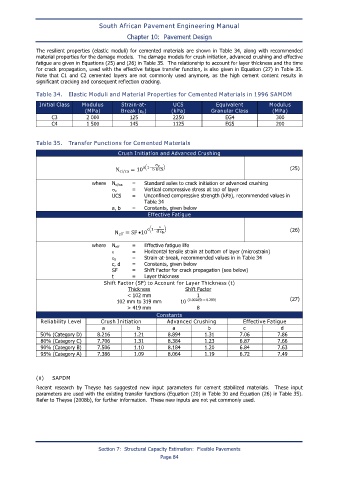
              The resilient  properties  (elastic moduli)  for cemented materials  are shown in  Table 34, along with recommended
              material properties for the damage models.  The damage models for crush initiation, advanced crushing and effective
              fatigue are given in Equations (25) and (26) in Table 35.  The relationship to account for layer thickness and the time
              for crack propagation, used with the effective fatigue transfer function, is also given in Equation (27) in Table 35.
              Note that C1 and  C2 cemented layers  are not commonly  used anymore,  as the high cement content results in
              significant cracking and consequent reflection cracking.

              Table 34.  Elastic Moduli and Material Properties for Cemented Materials in 1996 SAMDM
               Initial Class   Modulus      Strain-at-        UCS            Equivalent         Modulus
                               (MPa)        Break (ε b )     (kPa)         Granular Class        (MPa)
                   C3          2 000           125            2250              EG4               300
                   C4          1 500           145            1125              EG5               200


              Table 35.  Transfer Functions for Cemented Materials

                                           Crush Initiation and Advanced Crushing

                                                        σ v
                                                          �
                                                   a�1− b UCS                                          (25)
                                          N    = 10
                                           ci/ca

                                               =    Standard axles to crack initiation or advanced crushing
                                 where  N ci/ca
                                        σ v    =    Vertical compressive stress at top of layer
                                        UCS    =    Unconfined compressive strength (kPa), recommended values in
                                                    Table 34
                                        a, b   =    Constants, given below
                                                     Effective Fatigue

                                                         ε
                                                     c�1−  �                                           (26)
                                         N eff  = SF •10  d ε b

                                               =    Effective fatigue life
                                 where  N eff
                                        ε      =    Horizontal tensile strain at bottom of layer (microstrain)
                                               =    Strain-at-break, recommended values in in Table 34
                                        ε b
                                        c, d   =    Constants, given below
                                        SF     =    Shift Factor for crack propagation (see below)
                                        t      =    Layer thickness
                                      Shift Factor (SF) to Account for Layer Thickness (t)
                                              Thickness           Shift Factor
                                              < 102 mm                1
                                          102 mm to 319 mm      10  (0.00285t – 0.293)                 (27)
                                              > 419 mm                8
                                                        Constants
               Reliability Level    Crush Initiation        Advanced Crushing         Effective Fatigue
                                     a           b            a           b           c             d
               50% (Category D)    8.216        1.21        8.894        1.31        7.06         7.86
               80% (Category C)    7.706        1.31        8.384        1.23        6.87         7.66
               90% (Category B)    7.506        1.10        8.184        1.20        6.84         7.63
               95% (Category A)    7.386        1.09        8.064        1.19        6.72         7.49


              (ii)   SAPDM
              Recent  research by Theyse  has suggested new input parameters for cement  stabilized materials.  These input
              parameters are used with the existing transfer functions (Equation (20) in Table 30 and Equation (26) in Table 35).
              Refer to Theyse (2008b), for further information.  These new inputs are not yet commonly used.


                                    Section 7:  Structural Capacity Estimation:  Flexible Pavements
                                                         Page 84

