


Page 96 - SAPEM-Chapter-10-2nd-edition-2014
P. 96
South African Pavement Engineering Manual
                                              Chapter 10:  Pavement Design

              7.1.5 Subgrade Permanent Deformation

              (i)   1996 SAMDM
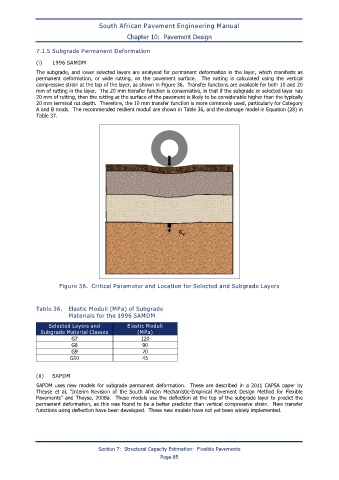
              The subgrade, and lower selected layers are analysed for permanent deformation in the layer, which manifests as
              permanent  deformation,  or  wide  rutting,  on  the  pavement  surface.    The  rutting  is  calculated  using  the  vertical
              compressive strain at the top of the layer, as shown in Figure 36.  Transfer functions are available for both 10 and 20
              mm of rutting in the layer.  The 20 mm transfer function is conservative, in that if the subgrade or selected layer has
              20 mm of rutting, then the rutting at the surface of the pavement is likely to be considerable higher than the typically
              20 mm terminal rut depth.  Therefore, the 10 mm transfer function is more commonly used, particularly for Category
              A and B roads.  The recommended resilient moduli are shown in Table 36, and the damage model in Equation (28) in
              Table 37.


                                                                ε v


                      Figure 36.  Critical Parameter and Location for Selected and Subgrade Layers


              Table 36.  Elastic Moduli (MPa) of Subgrade
                         Materials for the 1996 SAMDM

                  Selected Layers and         Elastic Moduli
               Subgrade Material Classes         (MPa)
                          G7                       120
                          G8                       90
                          G9                       70
                          G10                      45


              (ii)   SAPDM
              SAPDM  uses new models for subgrade permanent  deformation.  These are described  in a 2011 CAPSA paper by
              Theyse et al, “Interim Revision of the South African Mechanistic-Empirical Pavement  Design Method for Flexible
              Pavements” and Theyse, 2008a.  These models use the deflection at the top of the subgrade layer to predict the
              permanent deformation, as this was found to be a better predictor than vertical compressive strain.  New transfer
              functions using deflection have been developed.  These new models have not yet been widely implemented.


                                    Section 7:  Structural Capacity Estimation:  Flexible Pavements
                                                         Page 85

