


Page 213 - Candi Indonesia (Jawa)
P. 213
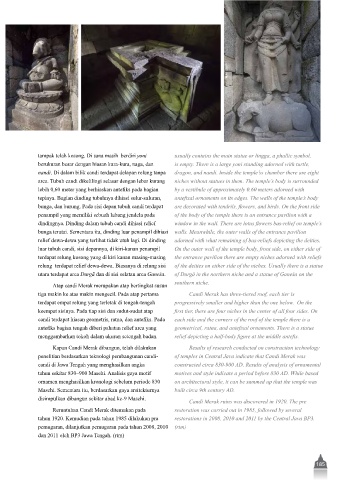
tampak telah kosong. Di sana masih  berdiri \RQL     usually contains the main statue or lingga, a phallic symbol,
                berukuran besar dengan hiasan kura-kura, naga, dan   is empty. There is a large yoni standing adorned with turtle,
                nandi. Di dalam bilik candi terdapat delapan relung tanpa   dragon, and nandi. Inside the temple’ss chamber there are eight
                arca. Tubuh candi dikelilingi selasar dengan lebar kurang   niches without statues in them. The temple’s body is surrounded
                OHELK      PHWHU \DQJ EHUKLDVNDQ DQWH¿NV SDGD EDJLDQ   by a vestibule of approximately 0.60 meters adorned with

                tepinya. Bagian dinding tubuhnya dihiasi sulur-suluran,   DQWH¿[DO RUQDPHQWV RQ LWV HGJHV  7KH ZDOOV RI WKH WHPSOH¶V ERG\
                bunga, dan burung. Pada sisi depan tubuh candi terdapat   DUH GHFRUDWHG ZLWK WHQGULOV  ÀRZHUV  DQG ELUGV  2Q WKH IURQW VLGH
                penampil yang memiliki sebuah lubang jendela pada    of the body of the temple there is an entrance pavilion with a
                dindingnya. Dinding dalam tubuh candi dihiasi relief   ZLQGRZ LQ WKH ZDOO  7KHUH DUH ORWXV ÀRZHUV EDV UHOLHI RQ WHPSOH¶V
                bunga teratai. Sementara itu, dinding luar penampil dihiasi  walls. Meanwhile, the outer walls of the entrance pavilion
                relief dewa-dewa yang terlihat tidak utuh lagi. Di dinding   DGRUQHG ZLWK ZKDW UHPDLQLQJ RI EDV UHOLHIV GHSLFWLQJ WKH GHLWLHV
                luar tubuh candi, sisi depannya, di kiri-kanan penampil   2Q WKH RXWHU ZDOO RI WKH WHPSOH ERG\  IURQW VLGH  RQ HLWKHU VLGH RI
                terdapat relung kosong yang di kiri kanan masing-masing   the entrance pavilion there are empty niches adorned with reliefs
                relung  terdapat relief dewa-dewa. Biasanya di relung sisi   of the deities on either side of the niches. Usually there is a statue
                utara terdapat arca 'XUJƗ dan di sisi selatan arca *DQHĞD.   RI 'XUJƗ LQ WKH QRUWKHUQ QLFKH DQG D VWDWXH RI *DQHĞD RQ WKH
                                                                     southern niche.
                      Atap candi Merak merupakan atap bertingkat susun
                tiga makin ke atas makin mengecil. Pada atap pertama       &DQGL 0HUDN KDV WKUHH WLHUHG URRI  HDFK WLHU LV
                terdapat empat relung yang terletak di tengah-tengah   progressively smaller and higher than the one below.  2Q WKH
                keempat sisinya. Pada tiap sisi dan sudut-sudut atap   ¿UVW WLHU  WKHUH DUH IRXU QLFKHV LQ WKH FHQWHU RI DOO IRXU VLGHV  2Q
                FDQGL WHUGDSDW KLDVDQ JHRPHWULV  UDWQD  GDQ DQWH¿NV  3DGD   each side and the corners of the roof of the temple there is a
                DQWH¿NV EDJLDQ WHQJDK GLEHUL SDKDWDQ UHOLHI DUFD \DQJ   JHRPHWULFDO  UDWQD  DQG DQWH¿[DO RUQDPHQWV  7KHUH LV D VWDWXH
                menggambarkan tokoh dalam ukuran setengah badan.     UHOLHI GHSLFWLQJ D KDOI ERG\ ¿JXUH DW WKH PLGGOH DQWH¿[

                      Kapan Candi Merak dibangun, telah dilakukan          Results of research conducted on construction technology
                penelitian berdasarkan teknologi pembangunan candi-  of temples in Central Java indicate that Candi Merak was
                candi di Jawa Tengah yang menghasilkan angka         FRQVWUXFWHG FLUFD         $'  5HVXOWV RI DQDO\VLV RI RUQDPHQWDO
                tahun sekitar 830–900 Masehi. Analisis gaya motif    PRWLYHV DQG VW\OH LQGLFDWH D SHULRG EHIRUH     $'  :KLOH EDVHG
                ornamen menghasilkan kronologi sebelum periode 830   on architectural style, it can be summed up that the temple was
                Masehi. Sementara itu, berdasarkan gaya arsitekturnya   EXLOW FLUFD  WK FHQWXU\ $'
                disimpulkan dibangun sekitar abad ke-9 Masehi.
                                                                           &DQGL 0HUDN UXLQV ZDV GLVFRYHUHG LQ       7KH SUH
                      Reruntuhan Candi Merak ditemukan pada          UHVWRUDWLRQ ZDV FDUULHG RXW LQ       IROORZHG E\ VHYHUDO
                tahun 1920. Kemudian pada tahun 1985 dilakukan pra   UHVWRUDWLRQV LQ            DQG      E\ WKH &HQWUDO -DYD %3
                pemugaran, dilanjutkan pemugaran pada tahun 2008, 2010  (rtm)
                dan 2011 oleh BP3 Jawa Tengah. (rtm)


                                                                                                                            185

