


Page 348 - Candi Indonesia (Jawa)
P. 348
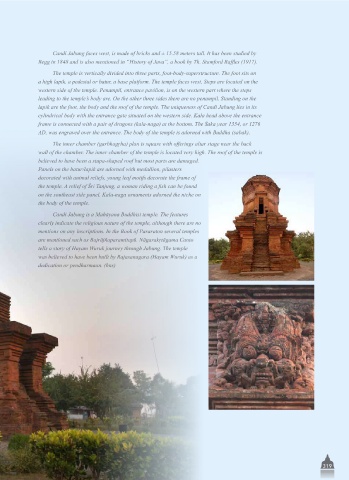
Candi Jabung faces west, is made   of bricks and ± 15.58 meters tall. It has been studied by
                5HJJ LQ      DQG LV DOVR PHQWLRQHG LQ ³+LVWRU\ RI -DYD´  D ERRN E\ 7K  6WDPIRUG 5DIÀHV

                      The temple is vertically divided into three parts, foot-body-superstructure. The foot sits on
                a high lapik, a pedestal or batur, a base platform. The temple faces west. Steps are located on the
                western side of the temple. Penampil, entrance pavilion, is on the western part where the steps
                leading to the temple’s body are. On the other three sides there are no penampil. Standing on the
                lapik are the foot, the body and the roof of the temple. The uniqueness of Candi Jabung lies in its
                cylindrical body with the entrance gate situated on the western side. Kala head above the entrance
                IUDPH LV FRQQHFWHG ZLWK D SDLU RI GUDJRQV  NDOD QDJD  DW WKH ERWWRP  7KH ĝDND \HDU       RU

                $'  ZDV HQJUDYHG RYHU WKH HQWUDQFH  7KH ERG\ RI WKH WHPSOH LV DGRUQHG ZLWK %XGGKD  VDEDN
                      7KH LQQHU FKDPEHU  JDUEKDJ܀KD  SODQ LV VTXDUH ZLWK RIIHULQJV DOWDU VWDJH QHDU WKH EDFN
                wall of the chamber. The inner chamber of the temple is located very high. The roof of the temple is
                believed to have been a stupa-shaped roof but most parts are damaged.
                Panels on the batur/lapik are adorned with medallion, pilasters
                decorated with animal reliefs, young leaf motifs decorate the frame of
                WKH WHPSOH  $ UHOLHI RI ĝUL 7DQMXQJ  D ZRPDQ ULGLQJ D ¿VK FDQ EH IRXQG

                on the southeast side panel. Kala-naga ornaments adorned the niche on
                the body of the temple.

                      &DQGL -DEXQJ LV D 0DKƗ\DQD %XGGKLVW WHPSOH  7KH IHDWXUHV
                clearly indicate the religious nature of the temple, although there are no
                mentions on any inscriptions. In the Book of Pararaton several temples
                DUH PHQWLRQHG VXFK DV %DMUƗMxDSDUDPLWDSnj  1ƗJDUDN܀WƗJDPD &DQWR
                WHOOV D VWRU\ RI +D\DP :XUXN MRXUQH\ WKURXJK -DEXQJ  7KH WHPSOH
                ZDV EHOLHYHG WR KDYH EHHQ EXLOW E\ 5DMDVDQDJDUD  +D\DP :XUXN  DV D
                GHGLFDWLRQ RU SHQGKDUPDDQ   KQV


                                                                                                                               319

