


Page 38 - THE SLOUGHI REVIEW SPECIAL ISSUE 7 B
P. 38
T H E   S L O U G H I   R E V I E W                                                                   3 8


        The Second World War brought much chaos and destruction, including to Germany. The

        sighthound population declined sharply (except for Italian greyhounds, which needed less
        food) and some kennels were even completely destroyed. In 1944, a total ban on breeding
        sighthounds was even imposed. Rebuilding all this after the war took a lot of time and
        effort. Added to this was the division between East and West Germany that began in 1945.
        Many connections remained: East German dogs were still registered in the West German
        studbook and East German kennel names were also registered in West Germany. Until
        this too was banned by the government.


        The German kennel club, ‘Verband für das Deutsche Hundewesen’ (VDH), was readmitted
        to the international organization FCI in 1950, and renewed membership of the UICL
        followed shortly afterwards. In 1951, the current name ‘Deutsche Windhundzucht- und
        Rennverband e.V.’ (DWZRV) was introduced.


        Breeding and racing are flourishing in these years. The current colours of the racing
        jackets are determined; the first six are still in use: 1 red, 2 blue, 3 white, 4 black, 5 yellow,
        6 black and white striped (both jacket number 7: black and white checkered and number
        8: red and white checkered are no longer in use, as the start is also limited to 6 hounds).
        And a previously unknown breed became very popular: the Afghan Hound. A breed whose
        representatives did not all perform very well on the track, incidentally. In 1959, the first

        racetrack had an endless hare* system, something that almost all racetracks now have.


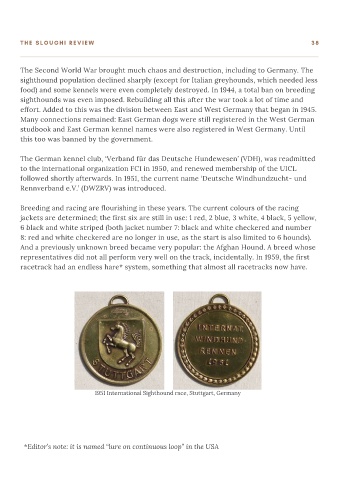
                                  1951 International Sighthound race, Stuttgart, Germany


         *Editor’s note: it is named “lure on continuous loop” in the USA

