


Page 37 - THE SLOUGHI REVIEW SPECIAL ISSUE 7 B
P. 37
T H E   S L O U G H I   R E V I E W                                                                   3 7


        Around 1909, Greyhounds, Whippets, and Italian Greyhounds already had a large circle of

        enthusiasts. To the dismay of many, the latter two breeds were often crossed with each
        other. The emergence of these short-haired breeds also gave a boost to sighthound
        racing, which until then had been practiced almost exclusively with Borzois. Breeding and
        racing were inseparable, or so the thinking went; good and sufficient exercise is a
        necessary condition for the growth and upbringing of a sighthound. This explains the
        combination of maintaining the studbook and organizing and regulating sighthound
        racing, a combination which still exists today.


        Even then, people did not want to let the dogs run without regulation. Already in 1910, the
        first German racing regulations were therefore established. In 1921, the first two regional
        sighthound racing associations were founded. As early as 1927, a height restriction was
        introduced for Whippets, something that is still a subject of debate today.


        At a competition in Duisburg in 1931, the 70 registered dogs ran behind a mechanically
        propelled hare for the first time, witnessed by 2000 spectators.


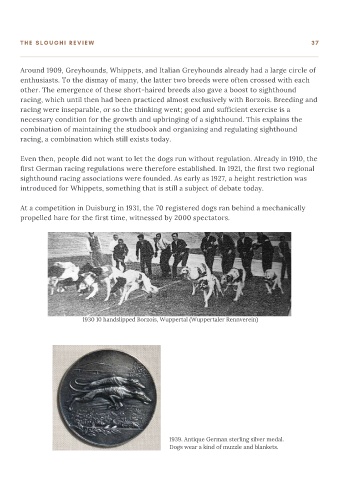
                              1930 10 handslipped Borzois, Wuppertal (Wuppertaler Rennverein)


                                                             1939. Antique German sterling silver medal.
                                                             Dogs wear a kind of muzzle and blankets.

