


Page 205 - [Uma_Sekaran]_Research_methods_for_business__a_sk(BookZZ.org)
P. 205
SCALES 189


                                             Now respond to Exercises 8.5 and 8.6.


            Ratio Scale
                             The ratio scale overcomes the disadvantage of the arbitrary origin point of the
                             interval scale, in that it has an absolute (in contrast to an arbitrary) zero point,
                             which is a meaningful measurement point. Thus the ratio scale not only measures
                             the magnitude of the differences between points on the scale but also taps the
                             proportions in the differences. It is the most powerful of the four scales because
                             it has a unique zero origin (not an arbitrary origin) and subsumes all the proper-
                             ties of the other three scales. The weighing balance is a good example of a ratio
                             scale. It has an absolute (and not arbitrary) zero origin calibrated on it, which
                             allows us to calculate the ratio of the weights of two individuals. For instance, a
                             person weighing 250 pounds is twice as heavy as one who weighs 125 pounds.
                             Note that multiplying or dividing both of these numbers (250 and 125) by any
                             given number will preserve the ratio of 2:1. The measure of central tendency of
                             the ratio scale could be either the arithmetic or the geometric mean and the mea-
                             sure of dispersion could be either the standard deviation, or variance, or the coef-
                             ficient of variation. Some examples of ratio scales are those pertaining to actual
                             age, income, and the number of organizations individuals have worked for.
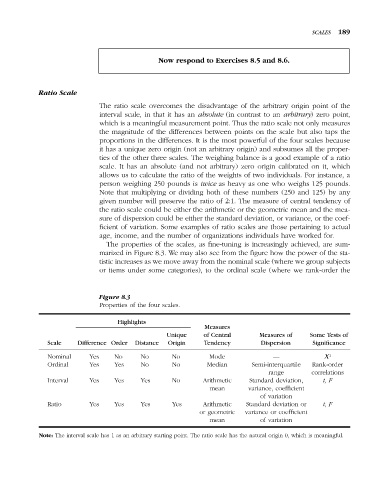
                               The properties of the scales, as fine-tuning is increasingly achieved, are sum-
                             marized in Figure 8.3. We may also see from the figure how the power of the sta-
                             tistic increases as we move away from the nominal scale (where we group subjects
                             or items under some categories), to the ordinal scale (where we rank-order the


                             Figure 8.3
                             Properties of the four scales.

                                  Highlights
                                                          Measures
                                               Unique     of Central     Measures of   Some Tests of
              Scale    Difference Order  Distance  Origin  Tendency      Dispersion     Significance
              Nominal     Yes    No     No       No        Mode              —             Χ 2
              Ordinal     Yes    Yes    No       No       Median       Semi-interquartile  Rank-order
                                                                            range      correlations
              Interval    Yes    Yes    Yes      No      Arithmetic   Standard deviation,    t, F
                                                           mean       variance, coefficient
                                                                         of variation
              Ratio       Yes    Yes    Yes      Yes     Arithmetic   Standard deviation or     t, F
                                                        or geometric   variance or coefficient
                                                           mean          of variation

            Note: The interval scale has 1 as an arbitrary starting point. The ratio scale has the natural origin 0, which is meaningful.

