


Page 204 - [Uma_Sekaran]_Research_methods_for_business__a_sk(BookZZ.org)
P. 204
188  MEASUREMENT OF VARIABLES: OPERATIONAL DEFINITION AND SCALES

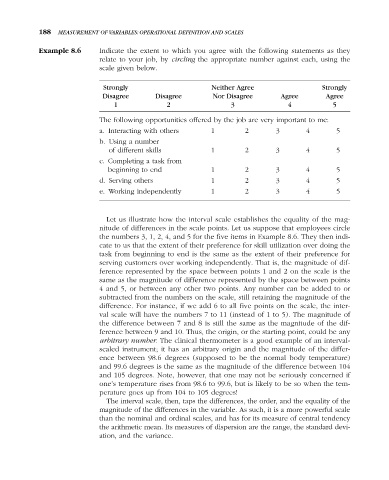
            Example 8.6      Indicate the extent to which you agree with the following statements as they
                             relate to your job, by circling the appropriate number against each, using the
                             scale given below.


                              Strongly                      Neither Agree                 Strongly
                              Disagree      Disagree        Nor Disagree       Agree       Agree
                                 1             2                 3               4           5
                             The following opportunities offered by the job are very important to me:
                             a. Interacting with others     1        2        3       4       5
                             b. Using a number
                               of different skills          1        2        3       4       5
                             c. Completing a task from
                               beginning to end             1        2        3       4       5
                             d. Serving others              1        2        3       4       5
                             e. Working independently       1        2        3       4       5


                               Let us illustrate how the interval scale establishes the equality of the mag-
                             nitude of differences in the scale points. Let us suppose that employees circle
                             the numbers 3, 1, 2, 4, and 5 for the five items in Example 8.6. They then indi-
                             cate to us that the extent of their preference for skill utilization over doing the
                             task from beginning to end is the same as the extent of their preference for
                             serving customers over working independently. That is, the magnitude of dif-
                             ference represented by the space between points 1 and 2 on the scale is the
                             same as the magnitude of difference represented by the space between points
                             4 and 5, or between any other two points. Any number can be added to or
                             subtracted from the numbers on the scale, still retaining the magnitude of the
                             difference. For instance, if we add 6 to all five points on the scale, the inter-
                             val scale will have the numbers 7 to 11 (instead of 1 to 5). The magnitude of
                             the difference between 7 and 8 is still the same as the magnitude of the dif-
                             ference between 9 and 10. Thus, the origin, or the starting point, could be any
                             arbitrary number. The clinical thermometer is a good example of an interval-
                             scaled instrument; it has an arbitrary origin and the magnitude of the differ-
                             ence between 98.6 degrees (supposed to be the normal body temperature)
                             and 99.6 degrees is the same as the magnitude of the difference between 104
                             and 105 degrees. Note, however, that one may not be seriously concerned if
                             one’s temperature rises from 98.6 to 99.6, but is likely to be so when the tem-
                             perature goes up from 104 to 105 degrees!
                               The interval scale, then, taps the differences, the order, and the equality of the
                             magnitude of the differences in the variable. As such, it is a more powerful scale
                             than the nominal and ordinal scales, and has for its measure of central tendency
                             the arithmetic mean. Its measures of dispersion are the range, the standard devi-
                             ation, and the variance.

