


Page 199 - [Uma_Sekaran]_Research_methods_for_business__a_sk(BookZZ.org)
P. 199
OPERATIONAL DEFINITION: DIMENSIONS AND ELEMENTS  183

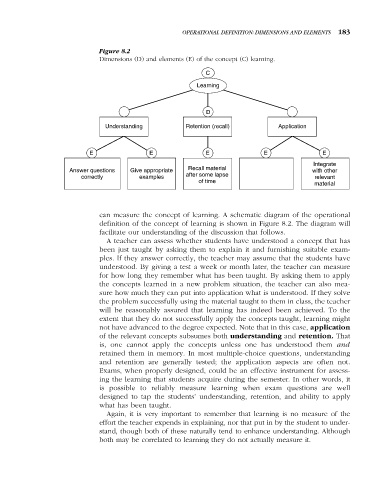
                             Figure 8.2
                             Dimensions (D) and elements (E) of the concept (C) learning.
                                                          C
                                                        Learning


                                   D                      D                       D

                              Understanding          Retention (recall)       Application


                          E               E               E               E                E
                                                                     Solve problems     Integrate
                    Answer questions  Give appropriate  Recall material  applying concepts  with other
                        correctly       examples     after some lapse  understood and   relevant
                                                        of time         recalled        material


                             can measure the concept of learning. A schematic diagram of the operational
                             definition of the concept of learning is shown in Figure 8.2. The diagram will
                             facilitate our understanding of the discussion that follows.
                               A teacher can assess whether students have understood a concept that has
                             been just taught by asking them to explain it and furnishing suitable exam-
                             ples. If they answer correctly, the teacher may assume that the students have
                             understood. By giving a test a week or month later, the teacher can measure
                             for how long they remember what has been taught. By asking them to apply
                             the concepts learned in a new problem situation, the teacher can also mea-
                             sure how much they can put into application what is understood. If they solve
                             the problem successfully using the material taught to them in class, the teacher
                             will be reasonably assured that learning has indeed been achieved. To the
                             extent that they do not successfully apply the concepts taught, learning might
                             not have advanced to the degree expected. Note that in this case, application
                             of the relevant concepts subsumes both understanding and retention. That
                             is, one cannot apply the concepts unless one has understood them  and
                             retained them in memory. In most multiple-choice questions, understanding
                             and retention are generally tested; the application aspects are often not.
                             Exams, when properly designed, could be an effective instrument for assess-
                             ing the learning that students acquire during the semester. In other words, it
                             is possible to reliably measure learning when exam questions are well
                             designed to tap the students’ understanding, retention, and ability to apply
                             what has been taught.
                               Again, it is very important to remember that learning is no measure of the
                             effort the teacher expends in explaining, nor that put in by the student to under-
                             stand, though both of these naturally tend to enhance understanding. Although
                             both may be correlated to learning they do not actually measure it.

