


Page 197 - [Uma_Sekaran]_Research_methods_for_business__a_sk(BookZZ.org)
P. 197
OPERATIONAL DEFINITION: DIMENSIONS AND ELEMENTS  181

                              1. To what extent would you say you push yourself to get the job done on time?
                              2. How difficult do you find it to continue to do your work in the face of ini-
                                tial failures or discouraging results?
                              3. How often do you neglect personal matters because you are preoccupied
                                with your job?
                              4. How frequently do you think of your work when you are at home?
                              5. To what extent do you engage yourself in hobbies?
                              6. How disappointed would you feel if you did not reach the goals you had set
                                for yourself?
                              7. How much do you concentrate on achieving your goals?
                              8. How annoyed do you get when you make mistakes?
                              9. To what extent would you prefer to work with a friendly but incompetent
                                colleague, rather than a difficult but competent one?
                             10. To what extent would you prefer to work by yourself rather than with others?
                             11. To what extent would you prefer a job that is difficult but challenging, to
                                one that is easy and routine?
                             12. To what extent would you prefer to take on extremely difficult assignments
                                rather than moderately challenging ones?
                             13. During the past 3 months, how often have you sought feedback from your
                                superiors on how well you are performing your job?
                             14. How often have you tried to obtain feedback on your performance from
                                your co-workers during the past 3 months?
                             15. How often during the past 3 months have you checked with your subor-
                                dinates that what you are doing is not getting in the way of their efficient
                                performance?
                             16. To what extent would it frustrate you if people did not give you feedback
                                on how you are progressing?

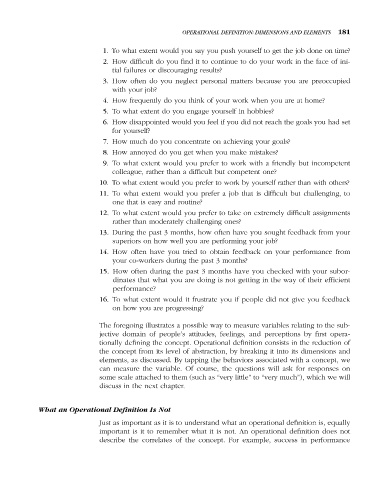
                             The foregoing illustrates a possible way to measure variables relating to the sub-
                             jective domain of people’s attitudes, feelings, and perceptions by first opera-
                             tionally defining the concept. Operational definition consists in the reduction of
                             the concept from its level of abstraction, by breaking it into its dimensions and
                             elements, as discussed. By tapping the behaviors associated with a concept, we
                             can measure the variable. Of course, the questions will ask for responses on
                             some scale attached to them (such as “very little” to “very much”), which we will
                             discuss in the next chapter.


            What an Operational Definition Is Not

                             Just as important as it is to understand what an operational definition is, equally
                             important is it to remember what it is not. An operational definition does not
                             describe the correlates of the concept. For example, success in performance

