


Page 202 - [Uma_Sekaran]_Research_methods_for_business__a_sk(BookZZ.org)
P. 202
186  MEASUREMENT OF VARIABLES: OPERATIONAL DEFINITION AND SCALES

                             American                  Japanese
                             Australian                Polish
                             Chinese                   Russian
                             German                    Swiss
                             Indian                    Zambian
                                          Other

                             Note that every respondent has to fit into one of the above eleven categories and
                             that the scale will allow computation of the numbers and percentage of respon-
                             dents that fit into them.


                                                 Now respond to Exercise 8.3.


            Ordinal Scale

                             An ordinal scale not only categorizes the variables in such a way as to denote
                             differences among the various categories, it also rank-orders the categories in
                             some meaningful way. With any variable for which the categories are to be
                             ordered according to some preference, the ordinal scale would be used. The
                             preference would be ranked (e.g., from best to worst; first to last) and numbered
                             1, 2, and so on. For example, respondents might be asked to indicate their pref-
                             erences by ranking the importance they attach to five distinct characteristics in a
                             job that the researcher might be interested in studying. Such a question might
                             take the following form:

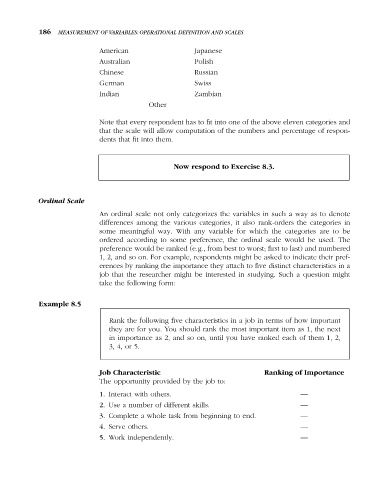
            Example 8.5

                               Rank the following five characteristics in a job in terms of how important
                               they are for you. You should rank the most important item as 1, the next
                               in importance as 2, and so on, until you have ranked each of them 1, 2,
                               3, 4, or 5.


                             Job Characteristic                           Ranking of Importance
                             The opportunity provided by the job to:
                             1. Interact with others.                               —
                             2. Use a number of different skills.                   —
                             3. Complete a whole task from beginning to end.        —
                             4. Serve others.                                       —
                             5. Work independently.                                 —

