


Page 280 - [Uma_Sekaran]_Research_methods_for_business__a_sk(BookZZ.org)
P. 280
264  SAMPLING

                              3. Identify the use of appropriate sampling designs for different research
                                purposes.
                              4. Explain why sample data are used to test hypotheses.
                              5. Discuss precision and confidence.
                              6. Estimate sample size.
                              7. Discuss the factors to be taken into consideration for determining sample size.
                              8. Discuss efficiency in sampling.
                              9. Discuss generalizability in the context of sampling designs.
                             10. Apply the material learned in this chapter to class assignments and projects.


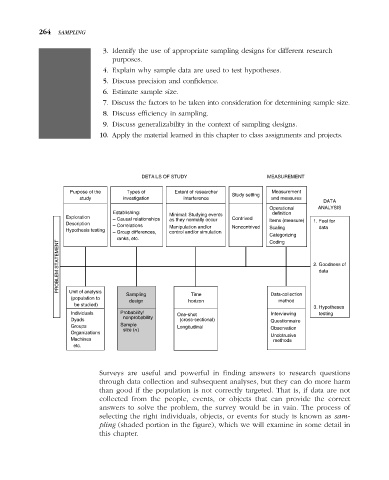
                                        DETAILS OF STUDY                   MEASUREMENT

                    Purpose of the  Types of     Extent of researcher       Measurement
                                                                 Study setting
                       study       investigation    interference            and measures
                                                                                           DATA
                                                                            Operational  ANALYSIS
                                Establishing:   Minimal: Studying events      definition
                   Exploration                                   Contrived
                                – Causal relationships  as they normally occur  Items (measure)  1. Feel for
                   Description
                                – Correlations  Manipulation and/or  Noncontrived  Scaling      data
                   Hypothesis testing
                                – Group differences,  control and/or simulation
                                                                            Categorizing
                                   ranks, etc.                              Coding
                 PROBLEM STATEMENT                                                      2. Goodness of
                                                                                            data
                    Unit of analysis
                                    Sampling          Time                  Data-collection
                     (population to
                                     design          horizon                  method
                      be studied)
                                                                                        3. Hypotheses
                     Individuals  Probability/    One-shot                  Interviewing      testing
                                    nonprobability
                     Dyads                          (cross-sectional)       Questionnaire
                     Groups       Sample          Longitudinal
                                    size (n)                                Observation
                     Organizations
                                                                            Unobtrusive
                     Machines                                                methods
                       etc.
                             Surveys are useful and powerful in finding answers to research questions
                             through data collection and subsequent analyses, but they can do more harm
                             than good if the population is not correctly targeted. That is, if data are not
                             collected from the people, events, or objects that can provide the correct
                             answers to solve the problem, the survey would be in vain. The process of
                             selecting the right individuals, objects, or events for study is known as sam-
                             pling (shaded portion in the figure), which we will examine in some detail in
                             this chapter.

