


Page 283 - [Uma_Sekaran]_Research_methods_for_business__a_sk(BookZZ.org)
P. 283
SAMPLING  267

                             or characteristics would make it possible for us to generalize such properties or
                             characteristics to the population elements. The characteristics of the population
                             such as µ (the population mean), σ (the population standard deviation), and σ 2
                             (the population variance) are referred to as its parameters. The central tenden-
                             cies, the dispersions, and other statistics in the sample of interest to the research
                             are treated as approximations of the central tendencies, dispersions, and other
                             parameters of the population. As such, all conclusions drawn about the sample
                             under study are generalized to the population. In other words, the sample sta-
                                    –
                                                                                2
                             tistics—X (the sample mean), S (standard deviation), and S (the variation in the
                                                                                             2
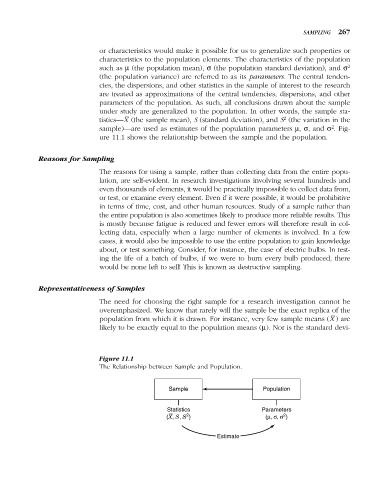
                             sample)—are used as estimates of the population parameters µ, σ, and σ . Fig-
                             ure 11.1 shows the relationship between the sample and the population.
            Reasons for Sampling
                             The reasons for using a sample, rather than collecting data from the entire popu-
                             lation, are self-evident. In research investigations involving several hundreds and
                             even thousands of elements, it would be practically impossible to collect data from,
                             or test, or examine every element. Even if it were possible, it would be prohibitive
                             in terms of time, cost, and other human resources. Study of a sample rather than
                             the entire population is also sometimes likely to produce more reliable results. This
                             is mostly because fatigue is reduced and fewer errors will therefore result in col-
                             lecting data, especially when a large number of elements is involved. In a few
                             cases, it would also be impossible to use the entire population to gain knowledge
                             about, or test something. Consider, for instance, the case of electric bulbs. In test-
                             ing the life of a batch of bulbs, if we were to burn every bulb produced, there
                             would be none left to sell! This is known as destructive sampling.


            Representativeness of Samples
                             The need for choosing the right sample for a research investigation cannot be
                             overemphasized. We know that rarely will the sample be the exact replica of the
                                                                                             –
                             population from which it is drawn. For instance, very few sample means (X ) are
                             likely to be exactly equal to the population means (µ). Nor is the standard devi-


                             Figure 11.1
                             The Relationship between Sample and Population.


                                                Sample                    Population


                                               Statistics                 Parameters
                                                     2
                                                                                2
                                               (X, S, S )                  (µ, σ, σ )
                                                             Estimate

