


Page 68 - Think 3. Teacher's Book B3+
P. 68
Unit 5
           Storytelling                     Culture


          Warmer
          To revise types of story, give                   Storytelling in the Caribbean
          students two minutes to think of as            14
          many different story genres as they
          can. After two minutes, play a game
          of ‘vocab tennis’, with each group
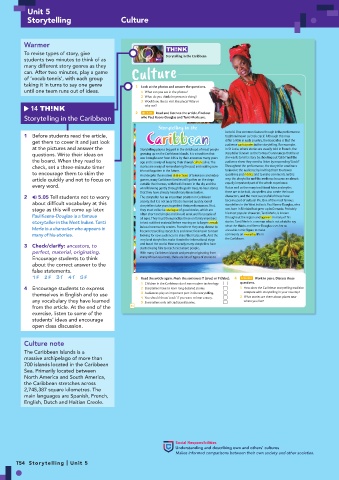
          taking it in turns to say one genre    1  Look at the photos and answer the questions.
          until one team runs out of ideas.        1  What can you see in the photos?
                                                   2  What do you think the person is doing?
                                                   3  Would you like to visit this place? Why or
            14                                      why not?
                                                 2   5.05   Read and listen to the article. Find out
          Storytelling in the Caribbean            who Paul Keens-Douglas and Tanti Merle are.
                                                         Storytelling in the
          1  Before students read the article,      Caribbean                   be told. One common feature though is the performance
                                                                                tradition known as ‘crick crack’. Although this may
            get them to cover it and just look                                  differ a little in each country, the basic idea is that the
                                                                                audience participates in the storytelling. For example,
            at the pictures and answer the        Storytelling plays a big part in the childhood of most people   in St Lucia, where stories are usually told in French, the
            questions. Write their ideas on       growing up on the Caribbean Islands. It is a tradition that   storyteller (known as the ‘conteur’) announces that he or
                                                                                she wants to tell a story by shouting out ‘Crick!’ and the
            the board. When they read to          was brought over from Africa by their ancestors many years   audience show they want to listen by responding ‘Crack!’
                                                  ago and is a way of keeping their shared culture alive. The
            check, set a three-minute timer       stories are a way of remembering the past and making sure   Throughout the performance, the storyteller continues
                                                                                to involve the audience by inviting them to answer
            to encourage them to skim the         it’s not forgotten in the future.  questions and riddles and to make comments. In this
                                                  And despite the modern distractions of television and video
            article quickly and not to focus on   games, many Caribbean families still gather on the steps   way, the storyteller and the audience become an almost
                                                                                equally important part of the whole experience.
            every word.                           outside their homes, with the full moon in the sky and the   But as well as the many traditional tales and myths
                                                  wind blowing gently through the palm trees, to hear stories
                                                  that they have already heard many times before.  there are to be told, storytellers also create their own
          2    5.05 Tell students not to worry    The storyteller has an important position in Caribbean   characters, and the most successful of these have
            about difficult vocabulary at this    society. But it is not an art that is learned quickly. Good   become part of cultural life. One of the most famous
                                                                                storytellers in the West Indies is Paul Keens-Douglas, who
                                                  storytellers take years to perfect their performances. First,
            stage as this will come up later.     they must collect a catalogue of good stories, which are   was born in Trinidad but grew up in Grenada. Probably
            Paul Keens-Douglas is a famous        often short and simple and should work well for people of   his most popular character, Tanti Merle, is known
                                                                                throughout the region and appears in many of his
                                                  all ages. They must then practise these on family members
            storyteller in the West Indies. Tanti   to test out their material before moving on to larger crowds   stories. Tanti Merle is a woman who is not afraid to say
            Merle is a character who appears in   in local community centres. From there they may choose to   what she thinks and Keens-Douglas uses her as
                                                                                a lovable comic figure to make
                                                  become travelling storytellers and move from town to town
            many of his stories.                  looking for new audiences to share their tales with. And the   comments on everyday life in
                                                  very best storytellers make it onto the international stage   the Caribbean.
          3  Check/clarify: ancestors, to         and travel the world. More recently many storytellers have
                                                  started using film to reach even more people.
            perfect, material, originating.       With many Caribbean islands and people originating from
            Encourage students to think           many African countries, there are lots of types of stories to
            about the correct answer to the
            false statements.
            1 F   2 F   3 T   4 T   5 F          3  Read the article again. Mark the sentences T (true) or F (false).  4   SPEAKING
                                                                                      SPEAKING   Work in pairs. Discuss these
                                                   1  Children in the Caribbean don’t use modern technology.   questions.
          4  Encourage students to express         2  Storytellers have to learn long detailed stories.   1  How does the Caribbean storytelling tradition
                                                                                       compare with storytelling in your country?
            themselves in English and to use       3  Audiences play an important part in the storytelling.   2  What stories are there about places near
            any vocabulary they have learned       4  You should shout ‘crack’ if you want to hear a story.   where you live?
                                                   5  Storytellers only tell traditional stories.
            from the article. At the end of the   54
            exercise, listen to some of the
            students’ ideas and encourage
            open class discussion.
          Culture note
          The Caribbean Islands is a
          massive archipelago of more than
          700 islands located in the Caribbean
          Sea. Primarily located between
          North America and South America,
          the Caribbean stretches across
          2,745,387 square kilometres. The
          main languages are Spanish, French,
          English, Dutch and Haitian Creole.


                                                               Social Responsibilities
                                                               Understanding and describing own and others’ cultures
                                                               Makes informed comparisons between their own society and other societies.
       T54  Storytelling | Unit 5

