


Page 63 - Think 3. Teacher's Book B3+
P. 63
Unit 5
          Storytelling                       Reading; Train to                ; Speaking


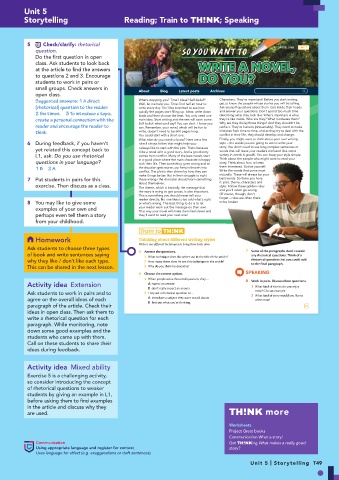
           5     Check/clarify: rhetorical
             question.                                           SO YOU WANT TO                   STORYTELLING  UNIT 5
             Do the first question in open
                                                                       WRITE A NOVEL,
             class. Ask students to look back                          WRITE A NOVEL,
             at the article to find the answers
                                                                       DO YOU?
             to questions 2 and 3. Encourage                           DO YOU?
             students to work in pairs or
             small groups. Check answers in       About   Blog    Latest posts   Archives
             open class.
             Suggested answers: 1 A direct        What’s stopping you? Time? Ideas? Self-belief?   Characters. They’re important! Before you start writing,
                                                                              get to know the people whose stories you will be telling.
                                                  Well, let me help you. Time: find half an hour to
             (rhetorical) question to the reader.     write every day. You’ll be surprised to see how   Ask yourself questions about them. Get inside their heads
             2 Six times.   3 To introduce a topic,   quickly the pages start filling up. Ideas: write down   and answer your questions. Don’t spend too much time
                                                                              describing what they look like. What’s important is what
                                                  loads and then choose the best. You only need one
             create a personal connection with the   main idea. Start writing and the rest will soon come.   they’re like inside. Who are they? What motivates them?
                                                                              Why are they doing those things? And they shouldn’t be
             reader and encourage the reader to   Self-belief: what can I say? You can do it. I know you   perfect. They’re humans (presumably). They need to make
                                                  can. Remember, your novel, which will be fun to
             think.                               write, doesn’t need to be 600 pages long.   mistakes from time to time, and as they try to deal with the
                                                  You could start with a short one.  conflict in their life, they should develop and change.
                                                  What else do you need to know? Here are a few   Finally, you might want to think about your own writing
           6  During feedback, if you haven’t     rules I always follow that might help you:  style – the words you are going to use to write your
             yet related this concept back to     I always like to start with the plot. That’s because   story. You don’t need to use long complex sentences or
                                                                              words that will leave your readers confused (but some
                                                  I like a novel with a good story. And a good story
             L1, ask: Do you use rhetorical       comes from conflict. Many of the best novels start   variety in words is good!). You can keep your style simple.
                                                                              Think about the people who might want to read your
             questions in your language?          in a good place where the main character is happy   story. Think about how to keep
                                                  with their life. Then something goes wrong and as
             1 B   2 A                            the situation gets worse, our hero is thrown into   them interested. But be yourself.
                                                  conflict. The plot is then driven by how they can   Write the words that come most
                                                  make things better. But in their struggle to right   naturally. These will always be your
           7  Put students in pairs for this      these wrongs the character should learn something   best words. So there you have
                                                                              it: plot, theme, characters and
             exercise. Then discuss as a class.   about themselves.           style. Follow these golden rules
                                                  The theme, which is basically the message that
                                                  the story is trying to get across, is also important.   and you’ll never go wrong.
                                                  This is something you should never tell your   Of course, though, don’t
                                                  reader directly. No one likes to be told what’s right   forget – rules are often there
           8  You may like to give some           or what’s wrong. The best thing to do is to let   to be broken.
             examples of your own and             your reader work out the message on their own.
                                                  That way your novel will make them feel clever and
             perhaps even tell them a story       they’ll want to read your next one!
             from your childhood.
              Homework                            Thinking about different writing styles
                                                  Writers use different techniques to bring their texts alive.
           Ask students to choose three types                                          7  Some of the paragraphs don’t contain
           of book and write sentences saying     5  Answer the questions.               any rhetorical questions. Think of a
                                                    1  What technique does the writer use in the title of the article?
           why they like / don’t like each type.    2  How many times does he use this technique in the article?  rhetorical question that you could add
                                                                                         to the final paragraph.
           This can be shared in the next lesson.   3  Why do you think he does this?
                                                  6  Choose the correct option.        SPEAKING
                                                    1  When people ask a rhetorical question, they …  8  Work in pairs. Discuss these questions.
           Activity idea  Extension                  A expect an answer.                 1  What kind of stories do you enjoy
                                                     B  don’t really expect an answer.
                                                                                           most? Give an example.
           Ask students to work in pairs and to     2  They ask a rhetorical question to …  2  What kind of story would you like to
           agree on the overall ideas of each         A  introduce a subject they want to talk about.  write most?
                                                     B  find out what you’re thinking.
           paragraph of the article. Check their                                                            49
           ideas in open class. Then ask them to
           write a rhetorical question for each
           paragraph. While monitoring, note
           down some good examples and the
           students who came up with them.
           Call on these students to share their
           ideas during feedback.
           Activity idea  Mixed ability
           Exercise 5 is a challenging activity,
           so consider introducing the concept
           of rhetorical questions to weaker
           students by giving an example in L1,
           before asking them to find examples
           in the article and discuss why they
           are used.                                                                          more

                                                                                  Worksheets
                                                                                  Project Great books
                                                                                  Communication What a story!
              Communication                                                       Get     ing What makes a really good
              Using appropriate language and register for context                 story?
              Uses language for effect (e.g. exaggerations or cleft sentences).
                                                                                         Unit 5 | Storytelling T49

