


Page 162 - JoFA_2022
P. 162
TAX MATTERS


         complicated calculation of the recapture   began W.R. Huff Asset Management Co.   could be entered into for profit, it had
         amount on Form 8828, Recapture of   in 1984. The business was successful, and   often seen cases where a horse-breeding
         Federal Mortgage Subsidy.        in 2005 Forbes reported Huff’s net worth   activity did not have a legitimate profit-
                                          as $750 million. In 1987, Huff purchased   making purpose. It quoted Helmick, T.C.
         Don’t leave money on the table   a farm in New Jersey where he and his   Memo. 2009-220, in observing that the
         Based on the potential tax credits and   wife lived and purchased additional land   “stereotypical abusive scenario ... is the
         the limited reach of the recapture rules,   adjacent to the farm in the late 1990s on   wealthy businessman who runs a real
         qualifying taxpayers should take ad-  which their daughter lived.   business during the week ... and owns a
         vantage of the mortgage interest credit.   In 2004, Huff and his wife formed   ‘gentleman’s farm’ as a weekend retreat
         As the example shows, a taxpayer who   Ecotone Farm LLC, of which they were   where he keeps horses for the recreation
         qualifies but does not apply for the credit   the sole owners. Ecotone’s operating   of himself and his family and friends.”
         could be leaving a significant amount of   agreement said it was organized for   Such a taxpayer “dabbles in breeding
         money on the table.              “agricultural and equestrian or equine   horses, with no expectation of ever
           To find out more about the mortgage   purposes including ... breeding and   making a profit, so that he can deduct the
         interest credit and how it is admin-  raising animals.” By 2010, the Huffs had   expenses of his horses and thereby have
         istered, homebuyers should contact   settled on Ecotone’s activity as breeding   Uncle Sam subsidize the weekend farm”
         their state or local government housing   miniature donkeys, after conducting   (Helmick, slip op. at 7).
         agency authorized to issue MCCs.  research assisted by Huff’s staff at his as-  Because the Huffs were the sole mem-
                                          set management company. Huff also ob-  bers of Ecotone, the Tax Court looked to
         — Travis Wheeler, CPA, M. Acc., is   tained advice from a friend with extensive   their actions in running it to determine
         a manager at Rudd & Co. PLLC in   experience in the field, who continued to   whether there was a profit motive for
         Rexburg, Idaho.                  serve as an adviser after Ecotone began   the donkey-breeding activity. The court
                                          the donkey-breeding activity.     applied the nine objective factors in Regs.
                                             Huff intended to develop the min-  Sec. 1.183-2(b) for determining whether
                                          iature donkey business into profitability   a profit motive exists: (1) the manner in
                                          and then turn it over to his daughter. In   which the taxpayer carries on the activity;
                                          2010 through 2018, Ecotone purchased   (2) the expertise of the taxpayer or his
                                          25 donkeys and sold 20 of them.    or her advisers; (3) the time and effort
                                             Ecotone reported a net loss on its   expended by the taxpayer in carrying
                                          partnership returns each tax year for 2010   on the activity; (4) the expectation that
                                          through 2017 of between $21,594 (2010)   assets used in the activity may appreciate
                                          and $87,236 (2013). To that extent, the   in value; (5) the success of the taxpayer
                                          losses offset the Huffs’ adjusted gross   in carrying on other similar or dissimilar
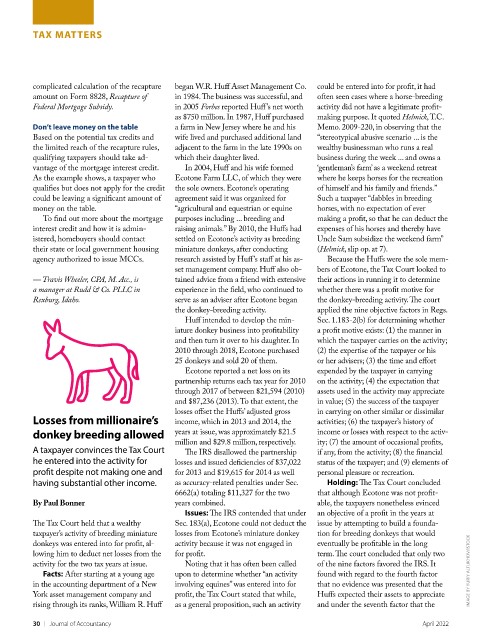
         Losses from millionaire’s        income, which in 2013 and 2014, the   activities; (6) the taxpayer’s history of
         donkey breeding allowed          years at issue, was approximately $21.5   income or losses with respect to the activ-
                                          million and $29.8 million, respectively.  ity; (7) the amount of occasional profits,
         A taxpayer convinces the Tax Court   The IRS disallowed the partnership   if any, from the activity; (8) the financial
         he entered into the activity for   losses and issued deficiencies of $37,022   status of the taxpayer; and (9) elements of
         profit despite not making one and   for 2013 and $19,615 for 2014 as well   personal pleasure or recreation.
         having substantial other income.   as accuracy-related penalties under Sec.   Holding: The Tax Court concluded
                                          6662(a) totaling $11,327 for the two   that although Ecotone was not profit-
         By Paul Bonner                   years combined.                   able, the taxpayers nonetheless evinced
                                             Issues: The IRS contended that under   an objective of a profit in the years at
         The Tax Court held that a wealthy   Sec. 183(a), Ecotone could not deduct the   issue by attempting to build a founda-
         taxpayer’s activity of breeding miniature   losses from Ecotone’s miniature donkey   tion for breeding donkeys that would
         donkeys was entered into for profit, al-  activity because it was not engaged in   eventually be profitable in the long
         lowing him to deduct net losses from the   for profit.             term. The court concluded that only two
         activity for the two tax years at issue.  Noting that it has often been called   of the nine factors favored the IRS. It
           Facts: After starting at a young age   upon to determine whether “an activity   found with regard to the fourth factor   IMAGE BY YURIY ALTUKHOV/ISTOCK
         in the accounting department of a New   involving equines” was entered into for   that no evidence was presented that the
         York asset management company and   profit, the Tax Court stated that while,   Huffs expected their assets to appreciate
         rising through its ranks, William R. Huff   as a general proposition, such an activity   and under the seventh factor that the

         30    |   Journal of Accountancy                                                            April 2022

