


Page 85 - JoFA_2022
P. 85
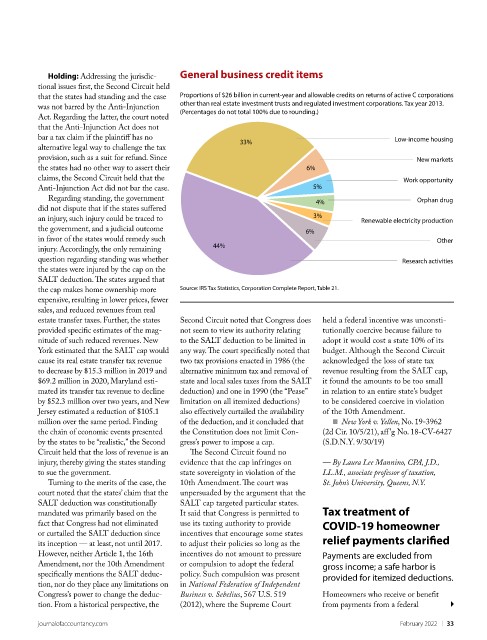
General business credit items
            Holding: Addressing the jurisdic-
          tional issues first, the Second Circuit held
                                            Proportions of $26 billion in current-year and allowable credits on returns of active C corporations
          that the states had standing and the case
                                            other than real estate investment trusts and regulated investment corporations. Tax year 2013.
          was not barred by the Anti-Injunction
                                            (Percentages do not total 100% due to rounding.)
          Act. Regarding the latter, the court noted
          that the Anti-Injunction Act does not
          bar a tax claim if the plaintiff has no                                             Low-income housing
                                                          33%
          alternative legal way to challenge the tax
          provision, such as a suit for refund. Since                                               New markets
          the states had no other way to assert their                     6%
          claims, the Second Circuit held that the                                              Work opportunity
          Anti-Injunction Act did not bar the case.                        5%
            Regarding standing, the government                                                      Orphan drug
                                                                            4%
          did not dispute that if the states suffered
                                                                           3%
          an injury, such injury could be traced to                                    Renewable electricity production
          the government, and a judicial outcome                         6%
          in favor of the states would remedy such                                                      Other
                                                   44%
          injury. Accordingly, the only remaining
          question regarding standing was whether                                               Research activities
          the states were injured by the cap on the
          SALT deduction. The states argued that
                                            Source: IRS Tax Statistics, Corporation Complete Report, Table 21.
          the cap makes home ownership more
          expensive, resulting in lower prices, fewer
          sales, and reduced revenues from real
          estate transfer taxes. Further, the states   Second Circuit noted that Congress does   held a federal incentive was unconsti-
          provided specific estimates of the mag-  not seem to view its authority relating   tutionally coercive because failure to
          nitude of such reduced revenues. New   to the SALT deduction to be limited in   adopt it would cost a state 10% of its
          York estimated that the SALT cap would   any way. The court specifically noted that   budget. Although the Second Circuit
          cause its real estate transfer tax revenue   two tax provisions enacted in 1986 (the   acknowledged the loss of state tax
          to decrease by $15.3 million in 2019 and   alternative minimum tax and removal of   revenue resulting from the SALT cap,
          $69.2 million in 2020, Maryland esti-  state and local sales taxes from the SALT   it found the amounts to be too small
          mated its transfer tax revenue to decline   deduction) and one in 1990 (the “Pease”   in relation to an entire state’s budget
          by $52.3 million over two years, and New   limitation on all itemized deductions)   to be considered coercive in violation
          Jersey estimated a reduction of $105.1   also effectively curtailed the availability   of the 10th Amendment.
          million over the same period. Finding   of the deduction, and it concluded that   ■   New York v. Yellen, No. 19-3962
          the chain of economic events presented   the Constitution does not limit Con-  (2d Cir. 10/5/21), aff’g No. 18-CV-6427
          by the states to be “realistic,” the Second   gress’s power to impose a cap.   (S.D.N.Y. 9/30/19)
          Circuit held that the loss of revenue is an   The Second Circuit found no
          injury, thereby giving the states standing   evidence that the cap infringes on   — By Laura Lee Mannino, CPA, J.D.,
          to sue the government.            state sovereignty in violation of the   LL.M., associate professor of taxation,
            Turning to the merits of the case, the   10th Amendment. The court was   St. John’s University, Queens, N.Y.
          court noted that the states’ claim that the   unpersuaded by the argument that the
          SALT deduction was constitutionally   SALT cap targeted particular states.
          mandated was primarily based on the   It said that Congress is permitted to   Tax treatment of
                                                                             COVID-19 homeowner
          fact that Congress had not eliminated   use its taxing authority to provide
          or curtailed the SALT deduction since   incentives that encourage some states   relief payments clarified
          its inception — at least, not until 2017.   to adjust their policies so long as the
          However, neither Article 1, the 16th   incentives do not amount to pressure   Payments are excluded from
          Amendment, nor the 10th Amendment   or compulsion to adopt the federal   gross income; a safe harbor is
          specifically mentions the SALT deduc-  policy. Such compulsion was present   provided for itemized deductions.
          tion, nor do they place any limitations on   in National Federation of Independent
          Congress’s power to change the deduc-  Business v. Sebelius, 567 U.S. 519   Homeowners who receive or benefit
          tion. From a historical perspective, the   (2012), where the Supreme Court   from payments from a federal

          journalofaccountancy.com                                                              February 2022    |   33

