


Page 43 - EH72
P. 43
FACE TO FACE  |  EASTERN HORIZON     41


            I decided to pursue bhikkhunī ordination because it
           was designed by the Buddha to be the best form to make
           progress on this path, as a full renunciant. I have found
           that being a bhikkhunī is a wonderful opportunity to be
           naturally sheltered from all the praise, honor, and gain
           (that the Buddha says are bitter, vile, and obstructive to
           awakening!). Being bound by the precepts for all these
           years has been such an incredible gift of freedom.

           What have been your most joyful experience since
           becoming a Buddhist nun?


           The more I am in robes, the happier I am. It is truly
           a blessing! There are two activities that give me the   opportunity to share the Dhamma with them in a very
           most joy: translating scriptures from Pāli into both   personal way.
           English and Italian (my native language), and practicing
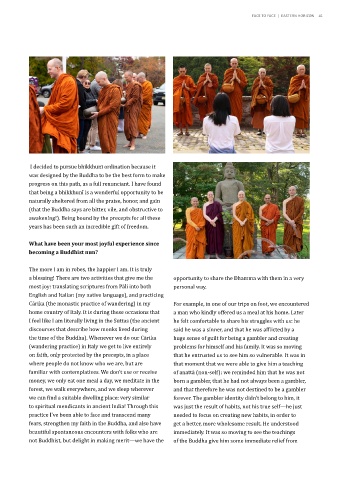
           Cārika (the monastic practice of wandering) in my   For example, in one of our trips on foot, we encountered
           home country of Italy. It is during these occasions that   a man who kindly offered us a meal at his home. Later
           I feel like I am literally living in the Suttas (the ancient   he felt comfortable to share his struggles with us: he
           discourses that describe how monks lived during    said he was a sinner, and that he was afflicted by a
           the time of the Buddha). Whenever we do our Cārika   huge sense of guilt for being a gambler and creating
           (wandering practice) in Italy we get to live entirely   problems for himself and his family. It was so moving
           on faith, only protected by the precepts, in a place   that he entrusted us to see him so vulnerable. It was in
           where people do not know who we are, but are       that moment that we were able to give him a teaching
           familiar with contemplatives. We don’t use or receive   of anattā (non-self): we reminded him that he was not
           money, we only eat one meal a day, we meditate in the   born a gambler, that he had not always been a gambler,
           forest, we walk everywhere, and we sleep wherever   and that therefore he was not destined to be a gambler
           we can find a suitable dwelling place: very similar   forever. The gambler identity didn’t belong to him, it
           to spiritual mendicants in ancient India! Through this   was just the result of habits, not his true self—he just
           practice I’ve been able to face and transcend many   needed to focus on creating new habits, in order to
           fears, strengthen my faith in the Buddha, and also have   get a better, more wholesome result. He understood
           beautiful spontaneous encounters with folks who are   immediately. It was so moving to see the teachings
           not Buddhist, but delight in making merit—we have the   of the Buddha give him some immediate relief from

