


Page 372 - Divyank Tyagi
P. 372
338   |  ChApter  9  ConCeptual Design anD Design analysis


                           the severity of the curved edge will be affected. This exercise was just one example of the
                           almost limitless number of ways you can use parameters and components to drive conceptual
                           geometry. We’re going to use this mass family to explore conceptual energy analysis in the next
                           section.

                           energy Modeling

                           Understanding a building’s energy needs is paramount to helping the project become more
                           sustainable. According to the U.S. Energy Information Administration (www.eia.doe.gov),
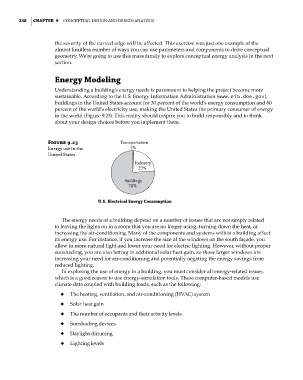
                           buildings in the United States account for 30 percent of the world’s energy consumption and 60
                           percent of the world’s electricity use, making the United States the primary consumer of energy
                           in the world (Figure 9.23). This reality should inspire you to build responsibly and to think
                           about your design choices before you implement them.


                        Figure 9.23               Transportation
                        energy use in the            1%
                        united states
                                                       Industry
                                                        23%

                                                   Buildings
                                                     76%


                                          U.S. Electrical Energy Consumption


                             The energy needs of a building depend on a number of issues that are not simply related
                           to leaving the lights on in a room that you are no longer using, turning down the heat, or
                           increasing the air-conditioning. Many of the components and systems within a building affect
                           its energy use. For instance, if you increase the size of the windows on the south façade, you
                           allow in more natural light and lower your need for electric lighting. However, without proper
                           sunshading, you are also letting in additional solar heat gain, so those larger windows are
                           increasing your need for air-conditioning and potentially negating the energy savings from
                           reduced lighting.
                             In exploring the use of energy in a building, you must consider all energy-related issues,
                           which is a good reason to use energy-simulation tools. These computer-based models use
                           climate data coupled with building loads, such as the following:
                             ◆ ◆ The heating, ventilation, and air-conditioning (HVAC) system
                             ◆ ◆ Solar heat gain
                             ◆ ◆ The number of occupants and their activity levels

                             ◆ ◆ Sunshading devices
                             ◆ ◆ Daylight dimming
                             ◆ ◆ Lighting levels


          c09.indd   338                                                                             5/3/2014   11:01:06 AM

