


Page 153 - Demo
P. 153
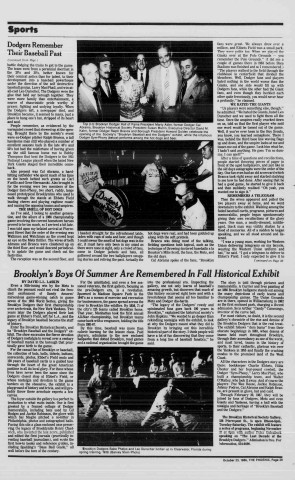
SportsDodgers Remember' I ' I ___? n l i i ni iie ir o a s e o a u r a s tContinued from Page 1battle dodging the trains to get to the game. The team went from a perennial doormat in the 20%u2019s and 30%u2019s, better known for their comical antics than for talent, to their development into a baseball powerhouse under the direction of the self destructive baseball genius, Larry MacPhail, and win-atall-cost Leo Durocher, The Dodgers were the glue that held our borough together. They were more family than entertainment, a source of chauvinistic pride worthy of prayer, fighting and undying loyalty. When the Dodgers left, a newspaper died, and Brooklyn became, it seemed to many, just a place to hang one%u2019s hat, stripped of its heart and soul.People remember, as evidenced by the variegated crowd that showed up at the opening. Brought there by the society%u2019s event were ex-Dodger pitcher Ralph Branca, a tall handsome man still who played a number of excellent seasons back in the late 40%u2019s and 50%u2019s but had the misfortune of having given up the still famous home run to Bobby Thompson that beat the Dodgers in the 1951 National League playoff when the hated New York Giants staged their incredible comeback.Also present was Cal Abrams, a hardhitting outfielder who spent much of his time on the bench behind such greats as Carl Furillo and Gene Hermanski. Also brought in for the evening were two members of the Dodger Sym-Phony, two short, ruddy, large nosed prototypical Brooklynites who used to walk through the stands at Ebbets Field leading cheers and playing ragtime music and razzing the opposing teams and umpires.THE SMELL OF HOT DOGSAs I%u2019ve said, I belong to another generation, and the allure of a 1986 championship game involving the current hometown heroes proved to be too much, so I arrived a bit late. I was told upon my belated arrival at Pierrepont Street that the order of the evening was Walkmen and Watchmen as the crowd kept an eye on the Mets thriller. The wives of both Abrams and Branca were cloistered up on the third floor, and would descend periodically to update the game and check out the festivities.The reception was on the second floor, andTop (l-rj: Brooklyn D odger Hall of Fam e P resident M arty Adler, fo rm er D odger CalA bram s, Brooklyn H istorical S ociety President S usan M ullin, E xecutive D irector David M.Kahn, fo rm er Dodger R alph Branca and Borough P resident H ow ard G olden c eleb rate theopen in g o f the S o c ie ty %u2019s \ousD odger Sym -Phony (below ) perform s among th e hot dogs and beer.im&MiI headed straight for the refreshment table, laden with cups of soda and beer, and though I could swear the smell of hot dogs was in the air, it must have only been in my mind as there were none in sight, only a crowd of fans, some in Dodger jackets and hats, all gathered around the two ballplayers swapping stories and reliving the past. Actually thehot dogs were real, and had been gobbled up along with the soft pretzels.Branca was doing most of the talking, fielding questions both topical, such as the technique of throwing doctored baseballs a la Houston%u2019s Mike Scott, the fans, the Mets, and the old days.Cal Abrams spoke of the fans, %u201cBrooklynfans were great. We always drew over a million, and Ebbets Field was a small park. Thpv were polite too. When we played the Giants over at the Polo Grounds %u2014 you remember the Polo Grounds.%u201d (I did see a couple of games there in 1963 before Shea Stadium was finished and so I remembered.) %u201cThe players walked to the field through the clubhouse in centerfield that divided the bleachers. Well, Dodger fans and players hated nothing in the world worse than the Giants, and one side would fill up with Dodgers fans, while the other had the Giant fans, and even though they heckled each other quite ferociously, you would never hear a profanity,%u201d he claimed.WE HATED THE GIANTS%u201cUs players were something else, though,%u201d he admitted. %u201cWe hated the Giants, hated Leo Durocher and we used to fight them all the time. Once the umpires really cracked down on us, told us that the first player who said one word would be tossed out of the game. Well, if you%u2019ve ever been in the Boy Scouts, you know, you learned semaphore. There I was, behind the third base line waving flags up and down, and the umpire looks at me and tosses me out of the game. I ask him what for, I hadn%u2019t said anything. He goes %u2018I%u2019m no dummy, I can spell!%u201d %u2019After a time of questions and recollections, people started throwing pieces of paper in front of the aged ballplayers, and just like in the old days autographs were the order of the day. One fan even had an old scorecard which Branca took right away and started studying to see how he had done. After seeing that he had a good game, he started to give it back and then suddenly realized %u201cOh yeah, you wanted me to sign it.%u201dREMEMBERS A TELEGRAMThen the wives appeared and pulled the two players away at home, and we went downstairs to the exhibit. Walking among the faded baseball cards, programs, pictures and memorabilia, people began spontaneously giving their own recollections of the glory years. One man, a neatly-dressed, middleaged, black man was visibly shaken by a flood of memories. All of a sudden he began speaking, and we all stood around and listened.%u201cI was a young man, working for Western Union delivering telegrams on my bicycle, wearing the Western Union uniform and hat,%u201d he said. %u201cI got a telegram to deliver to Ebbet%u2019s Field. I only expected to give it to Continued on Page 30Brooklyn%u2019s Boys O f Summer Are Remembered In F a ll Historical ExhibitBY DAVID L.L. LASKINEven a 16th-inning win by the Mets to clinch the pennant could not rival the frenzied excitement of Sandy Amoros%u2019 miraculous game-winning catch in game seven of the 1955 World Series, giving the Brooklyn Dodgers their first championship over arch-rivals, the New York Yankees. Two years later the Dodgers played their last game at Ebbet%u2019s Field, left for L.A., and the legacy of Brooklyn baseball became the stuff of history.Enter the Brooklyn Historical Society, and its %u201cBrooklyn Baseball and the Dodgers%u201d exhibit. The show excavates the fierce devotion of Dodgers nostalgia to reveal over a century of baseball mania in the borough that practically gave birth to the game.For the casual fan of Brooklyn or baseball, the collection of bats, balls, tickets, buttons, scorecards, photos, Ebbet%u2019s Field seats and 120 years of baseball cards is a guided tour through the heart of the great American pastime in all its local glory. For those whose lives have never been the same since the Dodgers closed shop at Ebbet%u2019s Field, or whose nostalgia and devotion to the game borders on the obsessive, the exhibit is a playground of history and trivia, and will probably throw these armchair experts a few curves.The foyer outside the gallery is a perfect introduction to what waits inside. One is first greeted by a framed collage of Dodger memorabilia, including bats used by Gil Hodges and Jackie Robinson, the glove with which Sal Maglie pitched a no-hitter in Philadelphia, photos and autographed balls. Facing this sits a glass enclosed case preserving the legacy of Brooklynite Henry Chad-%u2014 : - l- %u2014 :------ i l . i--------------------------- %u2014 u i:~ u iVI W A A U U I V V i l t V U U 1V > l / V A O W V 'l V /) p u U U d l I V Uand edited the first journals (practically inventing baseball journalism), and wrote the first how-to books and reference g%u2019lides, including Spalding%u2019s %u201cBase Ball Guide,%u201d all well before the turn of the century.For the uninitiated, and even a few seasoned veterans, the first gallery, focusing on the pre-Dodgers era, is a revelation. Spawned in Madison Square Park in the 1840%u2019s as a means of exercise and recreation for businessmen, the game spread across the river to Brooklyn like wildfire. By 1858, 71 of the city%u2019s 125 teams called Brooklyn home. That year, Manhattan took the first annual All-Star championship, but Brooklyn teams came back with a vengeance, holding the title from 1861-67.By this time, baseball was more than calorie burning for the leisure class. Paid players, admission to the new enclosed ballparks that dotted Brooklyn, road games and a national organization brought the gameinto the professional era. Inspecting the gallery, one not only learns of baseball%u2019s amazing growth, but discovers that much of this history occurred right here and with a feverishness that seems all too familiar to Mets and Dodger die-hards.%u201cThe legacy of the Dodgers%u2019 rowdy and opinionated fans goes back 100 years in Brooklyn,%u201d explained the historical society%u2019s John Hopkins. %u201cWe wanted to go deeper than rekindling nostalgia with the exhibit, to look at why the Dodgers meant what they did to Brooklyn by bringing out this incredible historical part of the story. I think people will have a lot of fun discovering that they come from a long line of baseball fanatics,%u201d he said.The story is told through pictures and memorabilia. A Currier and Ives painting of an 1866 Brooklyn ballgame stands out among the many depictions of early teams and championship games. The Union Grounds are in there, opened in Williamsburg in 1862 as the first enclosed park, charging a 10-cent admission. So is Arthur %u201cCandy%u201d Cummings, inventor of the curve ball.For most visitors, no doubt, it is the second gallery%u2019s chronicle of the rise and demise of the Brooklyn Dodgers that is the real treat. The exhibit follows %u201cdem bums%u201d from their obscure beginnings in 1883, when dozens of teams held court throughout Brooklyn, through their ascendancy as one of the worst, and most loved, teams in the history of sports, to their cathartic, glorious win over the Yankees in 1955 and finally the crushing exodus to the promised land of the West Coast.All the characters in the Dodgers story are there: bookkeeper Charlie Ebbets, Hilda Chester and her four-pound cowbell, the Dodger %u201cSym-Phony,%u201d Larry MacPhail, who built a championship team, and Walter O%u2019Malley, who took it away. And of course the players: Pee Wee Reese, Jackie Robinson, Johnny Podres, Cal Abrams and Ralph Branca, are present in glove, bat and card.Through February 20, 1987, they will be joined by fans of Dodgers, Mets and even Giants and Yankees, having a ball with the notalgia and heritage of %u201cBrooklyn Baseball and the Dodgers.%u201dB rooklyn D odgers B abe Phelps and Leo D u ro ch er lim b er up in C learw ater, Flo rid a duringspring training, 1939. (B arney Stein Photo)The Brooklyn Historical Society Gallery, 128 Pierrepont St., is open 12noon-5pm, Tuesday-Saturday. The exhibit will feature a series of programs, beginning Novemberspeaking on %u201cThe Last Decade of the Brooklyn Dodgers.%u201d Admission is free. For Information, 624-0890.O cto b er 23, 1986, TH E P H O E N IX , Page 29


