


Page 13 - Bulletin Vol 31 No 1 - Jan. - April 2026 FINAL_
P. 13
In Our Society |   NYSDA Legislative Victories


            There were two legislative victories of interest to Dentists in 2025 which originated with the New York State Dental

            Association. The first was the NYSDA Virtual Credit Card Bill, which takes effect on June 17, 2026. The law states
            that an insurance company must honor the dentist’s choice of payment method without delaying the payment. The
            law requires an insurance company to provide sufficient notice that they intend to make payment by a virtual cred-
            it card or other such payment that would involve            processing fees and allows the provider to chose an alterna-
            tive method of payment that does not impose a fee. However, be aware that once the insurance company sends
            the notice that they intend to pay by virtual credit card, the provider must respond within 30 days to refuse that
            method of payment and choose another.

            The second was the NYSDA dental hygiene collaborative practice expansion bill which will take effect on June 17,
            2027. The bill expands the settings where a dentist can have a collaborative agreement with a dental hygienist be-
            yond the currently allowed Article 28 hospital setting. The new settings include an   appropriately equipped school,
            a federally qualified health center, a long term care facility, a group home serving people with intellectual and de-
            velopmental disabilities, a facility serving veterans, a temporary housing facility, a prison, a drug treatment facility,
            a domestic violence shelter, and settings where homebound residents are unable to be moved for treatment. The
            dental hygienist can only perform procedures that do not require personal, direct supervision by a dentist. A dental
            hygienist can only have  a collaborative agreement with one dentist at a time. However, a dentist may have a col-
            laborative agreement with up to six hygienists at a time.

            For a deeper dive into these laws, see the article by Lance Plunkett, NYSDA General Council, in the March 2026
            issue of the New York State Dental Journal.


          In Our Society |  Advocacy  (continued)


          They advocated on three priority issues that affect practitioners, dental residents, and the public:

          1.  ERISA and the Improving Dental Administration (IDA) Act: The IDA Act seeks ERISA reform so that state dental
          insurance consumer and patient protection laws apply equally to patients covered by self-funded employer plans and
          fully insured plans. Nearly half of Americans receive coverage through self-funded employer plans. Some administra-
          tors of these plans assert ERISA preemption to avoid compliance with state laws on prompt payment, non-covered
          services, virtual credit cards, network leasing, and prior authorization continuity. The IDA Act would close these gaps
          and restore consistent protections for patients and providers.

          2.  Supporting Dental Residents: The Resident Education Deferred Interest (REDI) Act would ensure medical and den-
          tal residents receive interest-free deferment on student loan payments until completion of residency. This legislation
          was previously introduced but stalled on a procedural issue; we are optimistic it will advance this year. Passage would
          relieve financial pressure on residents and support the pipeline of clinical professionals.
                                                        Protecting and Restoring Federal Oral Health Infrastructure: We
                                                        urge  the  Department  of  Health  and  Human  Services  maintain
                                                        senior-level dental leadership and technical expertise across key
                                                        agencies including the CDC, CMS, HRSA, and NIH. Recent reduc-
                                                        tions in oral-health staffing have impaired federal efforts in sur-
                                                        veillance, disease prevention, training programs, care for under-
                                                        served  communities,  and dental  research. Restoring  these  posi-
                                                        tions is essential to protect public oral health and ensure contin-
                                                        ued federal support for the profession.
                                                        These visits demonstrate our collective commitment to advocacy
                                                        on behalf of our colleagues, trainees, and patients. Thank you to
                                                        everyone who participated and to those who continue to support
                                                        these critical initiatives.
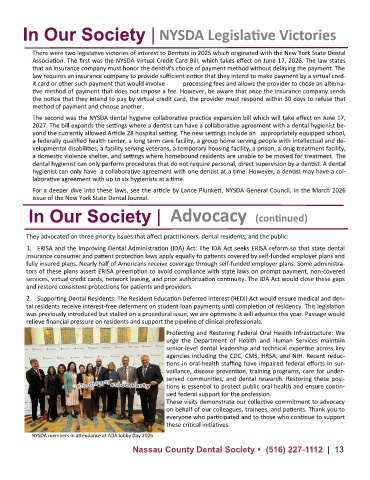
            NYSDA members in attendance at ADA lobby Day 2026

                                             Nassau County Dental Society ⬧  (516) 227-1112  |  13

