


Page 11 - Handout Digital Electronics
P. 11
Features of fourth generation computers


               •  They used Microprocessor (VLSI) as their main switching element.
               •  They are also called microphones or personal computers.
               •  Their size varies from desktop to laptop or palmtop.
               •  They  have  very  high  speed  of  processing;  they  are  100%  accurate,  reliable,   diligent and
                   versatile.
               •  They have very large storage capacity.

            Examples of the fourth-generation computers include: IBM PC, Apple-Macintosh and others.

            1.6 Fifth Generation (1991- onwards)

                        th
            Classifying  5   generation  according  to  technology  alone  is  debatable.  Some  authors  argue  that  the
                                                                                                               th
            technology  is  still  the  same  (integrated  circuits)  and  it  is  only  the  scaling  that  has  changed.5
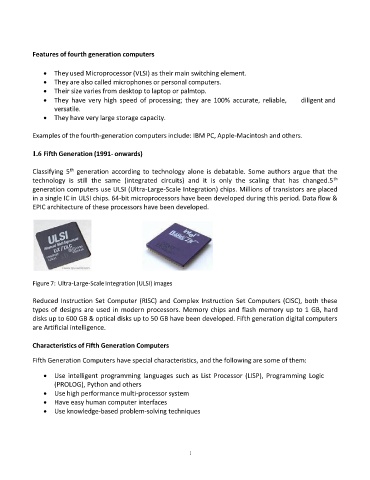
            generation computers use ULSI (Ultra-Large-Scale Integration) chips. Millions of transistors are placed
            in a single IC in ULSI chips. 64-bit microprocessors have been developed during this period. Data flow &
            EPIC architecture of these processors have been developed.


            Figure 7: Ultra-Large-Scale Integration (ULSI) images

            Reduced Instruction Set Computer (RISC) and Complex Instruction Set Computers (CISC), both these
            types of designs are used in modern processors. Memory chips and flash memory up to 1 GB, hard
            disks up to 600 GB & optical disks up to 50 GB have been developed. Fifth generation digital computers
            are Artificial intelligence.

            Characteristics of Fifth Generation Computers

            Fifth Generation Computers have special characteristics, and the following are some of them:

               •  Use intelligent programming  languages  such  as  List Processor  (LISP),  Programming  Logic
                   (PROLOG), Python and others
               •  Use high performance multi-processor system
               •  Have easy human computer interfaces
               •  Use knowledge-based problem-solving techniques


                                                                11

