


Page 7 - Handout Digital Electronics
P. 7
LECTURE 1 HISTORY OF COMPUTERS


            1.1 Introduction
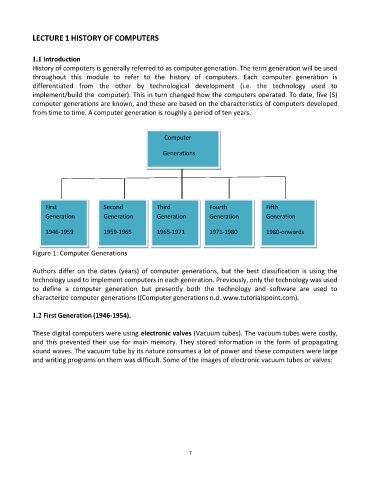
            History of computers is generally referred to as computer generation. The term generation will be used
            throughout  this  module  to  refer  to  the  history  of  computers.  Each  computer  generation  is
            differentiated  from  the  other  by  technological  development  (i.e.  the  technology  used  to
            implement/build the  computer). This in turn changed how the computers operated. To date, five (5)
            computer generations are known, and these are based on the characteristics of computers developed
            from time to time. A computer generation is roughly a period of ten years.


                                                       Computer

                                                       Generations


                First              Second            Third            Fourth             Fifth
                Generation         Generation        Generation       Generation         Generation

                1946-1959          1959-1965         1965-1971        1971-1980          1980-onwards


            Figure 1: Computer Generations

            Authors differ on the dates (years) of computer generations, but the best classification is using the
            technology used to implement computers in each generation. Previously, only the technology was used
            to  define  a  computer  generation  but  presently  both  the  technology  and  software  are  used  to
            characterize computer generations ((Computer generations n.d. www.tutorialspoint.com).

            1.2 First Generation (1946-1954).

            These digital computers were using electronic valves (Vacuum tubes). The vacuum tubes were costly,
            and this prevented their use for main memory. They stored information in the form of propagating
            sound waves. The vacuum tube by its nature consumes a lot of power and these computers were large
            and writing programs on them was difficult. Some of the images of electronic vacuum tubes or valves:


                                                                7

