


Page 117 - Handout Digital Electronics
P. 117
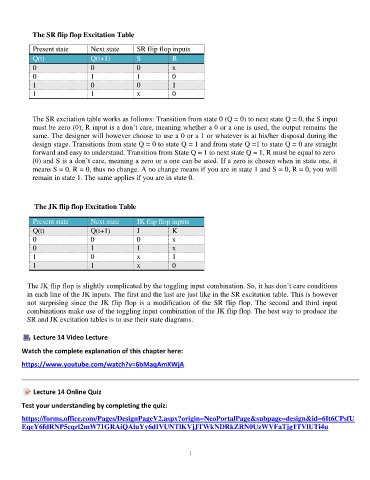
The SR flip flop Excitation Table

            Present state      Next state     SR flip flop inputs
            Q(t)               Q(t+1)         S           R
            0                  0              0           x
            0                  1              1           0
            1                  0              0           1
            1                  1              x           0


            The SR excitation table works as follows: Transition from state 0 (Q = 0) to next state Q = 0, the S input
            must be zero (0), R input is a don’t care, meaning whether a 0 or a one is used, the output remains the
            same. The designer will however choose to use a 0 or a 1 or whatever is at his/her disposal during the
            design stage. Transitions from state Q = 0 to state Q = 1 and from state Q =1 to state Q = 0 are straight
            forward and easy to understand. Transition from State Q = 1 to next state Q = 1, R must be equal to zero
            (0) and S is a don’t care, meaning a zero or a one can be used. If a zero is chosen when in state one, it
            means S = 0, R = 0, thus no change. A no change means if you are in state 1 and S = 0, R = 0, you will
            remain in state 1. The same applies if you are in state 0.


            The JK flip flop Excitation Table

            Present state      Next state     JK flip flop inputs
            Q(t)               Q(t+1)         J           K
            0                  0              0           x
            0                  1              1           x
            1                  0              x           1
            1                  1              x           0

          The JK flip flop is slightly complicated by the toggling input combination. So, it has don’t care conditions
          in each line of the JK inputs. The first and the last are just like in the SR excitation table. This is however
          not  surprising since the  JK flip  flop is  a modification of the SR flip  flop. The second and third input
          combinations make use of the toggling input combination of the JK flip flop. The best way to produce the
          SR and JK excitation tables is to use their state diagrams.

          Lecture 14 Video Lecture


        Watch the complete explanation of this chapter here:
        https://www.youtube.com/watch?v=6bMaqAmXWjA


          Lecture 14 Online Quiz


        Test your understanding by completing the quiz:
        https://forms.office.com/Pages/DesignPageV2.aspx?origin=NeoPortalPage&subpage=design&id=6It6CPsfU
        EqeY6fdRNP5cqrl2mW71GRAiQAluYy6dIVUNTlKVjJTWkNDRkZRN0UzWVFaTjg1TVlUTi4u

                                                                117

