


Page 114 - Handout Digital Electronics
P. 114
LECTURE 14 EDGE TRIGGERED FLIP FLOPS
            14.1 Positive edge transition and negative edge transition

            The edge triggered flip flops were developed to eliminate the JK flip flop problem of toggling more than
            once. The JK master-slave flip flop eliminates this problem, but it is expensive. The edge triggered flip
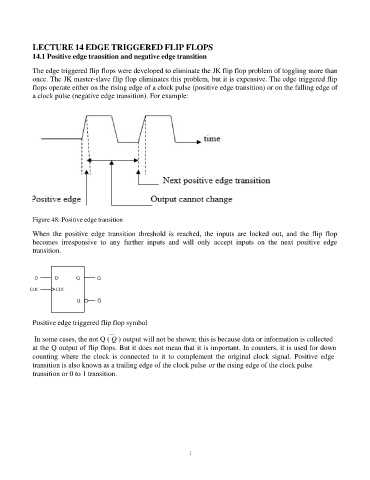
            flops operate either on the rising edge of a clock pulse (positive edge transition) or on the falling edge of
            a clock pulse (negative edge transition). For example:


            Figure 48: Positive edge transition

            When  the  positive  edge  transition  threshold  is  reached,  the  inputs  are  locked  out,  and  the  flip  flop
            becomes  irresponsive  to  any  further  inputs  and  will  only  accept  inputs  on  the  next  positive  edge
            transition.


            Positive edge triggered flip flop symbol

            In some cases, the not Q ( Q ) output will not be shown; this is because data or information is collected
            at the Q output of flip flops. But it does not mean that it is important. In counters, it is used for down
            counting  where  the  clock  is  connected  to  it  to  complement  the  original  clock  signal.  Positive  edge
            transition is also known as a trailing edge of the clock pulse or the rising edge of the clock pulse
            transition or 0 to 1 transition.


                                                                114

