


Page 109 - Handout Digital Electronics
P. 109
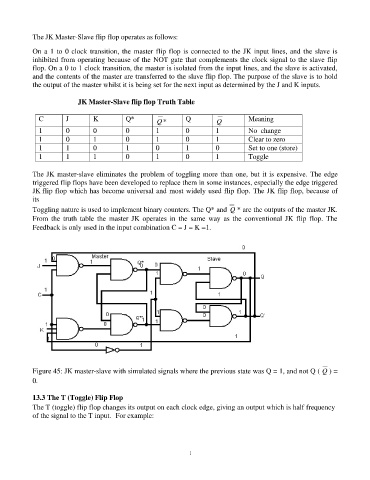
The JK Master-Slave flip flop operates as follows:

            On a 1 to 0 clock transition, the  master flip flop is connected to the JK input lines, and the slave is
            inhibited from operating because of the NOT gate that complements the clock signal to the slave flip
            flop. On a 0 to 1 clock transition, the master is isolated from the input lines, and the slave is activated,
            and the contents of the master are transferred to the slave flip flop. The purpose of the slave is to hold
            the output of the master whilst it is being set for the next input as determined by the J and K inputs.

                           JK Master-Slave flip flop Truth Table

              C        J        K          Q*         Q *     Q           Q        Meaning

              1        0        0          0         1        0         1          No  change
              1        0        1          0         1        0         1          Clear to zero
              1        1        0          1         0        1         0          Set to one (store)
              1        1        1          0         1        0         1          Toggle

            The JK master-slave eliminates the problem of toggling more than one, but it is expensive. The edge
            triggered flip flops have been developed to replace them in some instances, especially the edge triggered
            JK flip flop which has become universal and most widely used flip flop. The JK flip flop, because of
            its
            Toggling nature is used to implement binary counters. The Q* and  Q * are the outputs of the master JK.
            From  the  truth  table  the  master  JK  operates  in  the  same  way  as  the  conventional  JK  flip  flop.  The
            Feedback is only used in the input combination C = J = K =1.


            Figure 45: JK master-slave with simulated signals where the previous state was Q = 1, and not Q ( Q ) =
            0.

            13.3 The T (Toggle) Flip Flop
            The T (toggle) flip flop changes its output on each clock edge, giving an output which is half frequency
            of the signal to the T input.  For example:


                                                                109

