


Page 108 - Handout Digital Electronics
P. 108
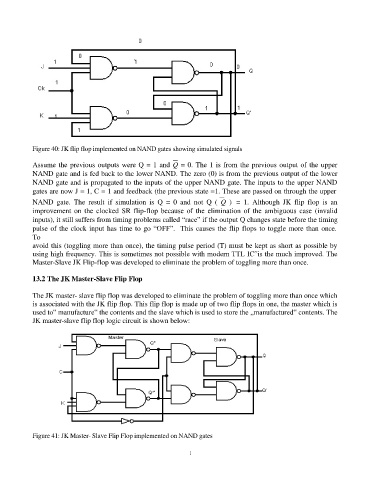
Figure 40: JK flip flop implemented on NAND gates showing simulated signals

            Assume the previous outputs were Q = 1 and Q = 0. The 1 is from the previous output of the upper
            NAND gate and is fed back to the lower NAND. The zero (0) is from the previous output of the lower
            NAND gate and is propagated to the inputs of the upper NAND gate. The inputs to the upper NAND
            gates are now J = 1, C = 1 and feedback (the previous state =1. These are passed on through the upper

            NAND  gate.  The  result  if  simulation  is  Q  =  0  and  not  Q  (  Q  )  =  1.  Although  JK  flip  flop  is  an
            improvement  on  the  clocked  SR  flip-flop  because  of  the  elimination  of  the  ambiguous  case  (invalid
            inputs), it still suffers from timing problems called “race” if the output Q changes state before the timing
            pulse of the clock input has time to go “OFF”.   This causes the flip flops to toggle more than once.
            To
            avoid this (toggling more than once), the timing pulse period (T) must be kept as short as possible by
            using high frequency. This is sometimes not possible with modern TTL IC‟is the much improved. The
            Master-Slave JK Flip-flop was developed to eliminate the problem of toggling more than once.


            13.2 The JK Master-Slave Flip Flop

            The JK master- slave flip flop was developed to eliminate the problem of toggling more than once which
            is associated with the JK flip flop. This flip flop is made up of two flip flops in one, the master which is
            used to‟ manufacture‟ the contents and the slave which is used to store the „manufactured‟ contents. The
            JK master-slave flip flop logic circuit is shown below:


            Figure 41: JK Master- Slave Flip Flop implemented on NAND gates


                                                                108

