


Page 106 - Handout Digital Electronics
P. 106
C         J         K          Q           Q          Name
            1         0         0          0          1           No change
            1         0         1          0          1           Reset (clear to 0)
            1         1         0          1          0           Set to 1 (store)
            1         1         1          0          1           Toggle


            Explanation of the toggle process in the JK flip flop implemented on AND and NOR gates When C
            =1, J = 1 and K =1, propagate the input values to the outputs of the NOR gates. Take the outputs and
            feed them back to the AND gates and propagate the inputs again to the outputs of the NOR gates. These
            are now the correct outputs. For example, consider the JK flip flop below with simulated values of the
            inputs:


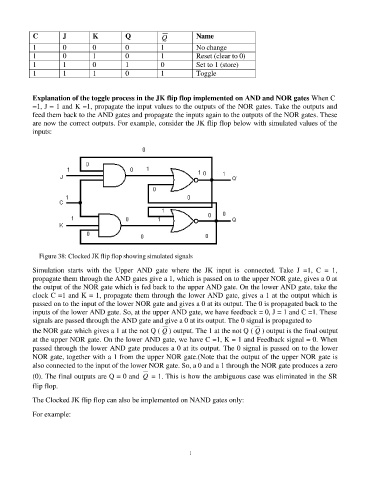
              Figure 38: Clocked JK flip flop showing simulated signals

            Simulation  starts  with  the  Upper  AND  gate  where  the  JK  input  is  connected.  Take  J  =1,  C  =  1,
            propagate them through the AND gates give a 1, which is passed on to the upper NOR gate, gives a 0 at
            the output of the NOR gate which is fed back to the upper AND gate. On the lower AND gate, take the
            clock C =1 and K = 1, propagate them through the lower AND gate, gives a 1 at the output which is
            passed on to the input of the lower NOR gate and gives a 0 at its output. The 0 is propagated back to the
            inputs of the lower AND gate. So, at the upper AND gate, we have feedback = 0, J = 1 and C =1. These
            signals are passed through the AND gate and give a 0 at its output. The 0 signal is propagated to
            the NOR gate which gives a 1 at the not Q ( Q ) output. The 1 at the not Q ( Q ) output is the final output
            at the upper NOR gate. On the lower AND gate, we have C =1, K = 1 and Feedback signal = 0. When
            passed through the lower AND gate produces a 0 at its output. The 0 signal is passed on to the lower
            NOR gate, together with a 1 from the upper NOR gate.(Note that the output of the upper NOR gate is
            also connected to the input of the lower NOR gate. So, a 0 and a 1 through the NOR gate produces a zero


            (0). The final outputs are Q = 0 and  Q  = 1. This is how the ambiguous case was eliminated in the SR
            flip flop.

            The Clocked JK flip flop can also be implemented on NAND gates only:

            For example:


                                                                106

