


Page 111 - Handout Digital Electronics
P. 111
13.4 The D (data) Flip flop
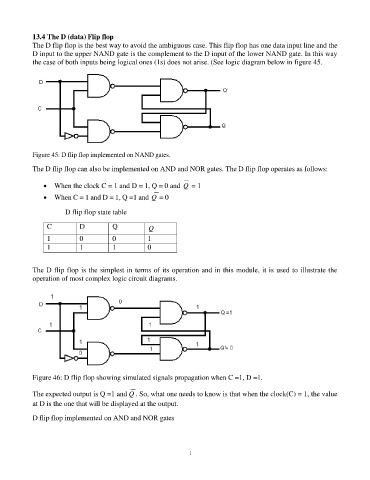
            The D flip flop is the best way to avoid the ambiguous case. This flip flop has one data input line and the
            D input to the upper NAND gate is the complement to the D input of the lower NAND gate. In this way
            the case of both inputs being logical ones (1s) does not arise. (See logic diagram below in figure 45.


            Figure 45: D flip flop implemented on NAND gates.

            The D flip flop can also be implemented on AND and NOR gates. The D flip flop operates as follows:

               •  When the clock C = 1 and D = 1, Q = 0 and Q  = 1

               •  When C = 1 and D = 1, Q =1 and Q = 0

                       D flip flop state table

                 C         D          Q           Q
                 1         0          0           1
                 1         1          1           0


            The D flip flop is the simplest in terms of its operation and in this module, it is used to illustrate the
            operation of most complex logic circuit diagrams.


            Figure 46: D flip flop showing simulated signals propagation when C =1, D =1.

            The expected output is Q =1 and Q . So, what one needs to know is that when the clock(C) = 1, the value
            at D is the one that will be displayed at the output.

            D flip flop implemented on AND and NOR gates


                                                                111

