


Page 95 - Community pharmcy practice E-book 2025
P. 95
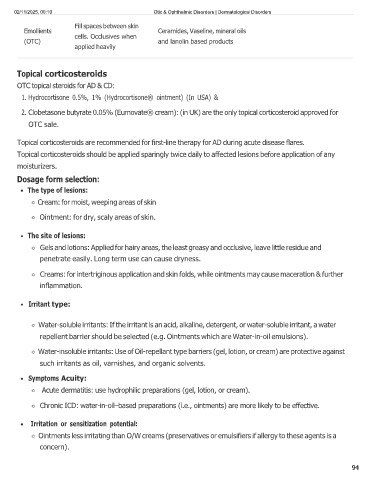
02/11/2025, 00:10  Fill spaces between skin  Otic & Ophthalmic Disorders | Dermatological Disorders
                   cells. Occlusives when
    Emollients     applied heavily             Ceramides, Vaseline, mineral oils
    (OTC)                                      and lanolin based products

Topical corticosteroids

OTC topical steroids for AD & CD:
 1. Hydrocortisone 0.5%, 1% (Hydrocortisone® ointment) (In USA) &
 2. Clobetasone butyrate 0.05% (Eumovate® cream): (in UK) are the only topical corticosteroid approved for
    OTC sale.

Topical corticosteroids are recommended for first-line therapy for AD during acute disease flares.
Topical corticosteroids should be applied sparingly twice daily to affected lesions before application of any
moisturizers.

Dosage form selection:

    The type of lesions:
        Cream: for moist, weeping areas of skin
         Ointment: for dry, scaly areas of skin.

    The site of lesions:
         Gels and lotions: Applied for hairy areas, the least greasy and occlusive, leave little residue and
         penetrate easily. Long term use can cause dryness.

         Creams: for intertriginous application and skin folds, while ointments may cause maceration & further
         inflammation.

    Irritant type:

        Water-soluble irritants: If the irritant is an acid, alkaline, detergent, or water-soluble irritant, a water
         repellent barrier should be selected (e.g. Ointments which are Water-in-oil emulsions).
        Water-insoluble irritants: Use of Oil-repellant type barriers (gel, lotion, or cream) are protective against
         such irritants as oil, varnishes, and organic solvents.
    Symptoms Acuity:
          Acute dermatitis: use hydrophilic preparations (gel, lotion, or cream).

         Chronic ICD: water-in-oil–based preparations (i.e., ointments) are more likely to be effective.

     Irritation or sensitization potential:
        Ointments less irritating than O/W creams (preservatives or emulsifiers if allergy to these agents is a
         concern).

                                                                                                                                                       94

