


Page 26 - Pharmaceutics III_ 02-06-01304_Fall 2025_ Pharm D_Electronic book
P. 26
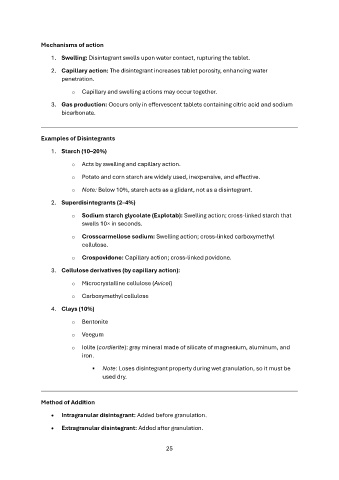
Mechanisms of action
    1. Swelling: Disintegrant swells upon water contact, rupturing the tablet.
    2. Capillary action: The disintegrant increases tablet porosity, enhancing water
         penetration.
              o Capillary and swelling actions may occur together.
    3. Gas production: Occurs only in effervescent tablets containing citric acid and sodium
         bicarbonate.

Examples of Disintegrants
    1. Starch (10–20%)
              o Acts by swelling and capillary action.
              o Potato and corn starch are widely used, inexpensive, and effective.
              o Note: Below 10%, starch acts as a glidant, not as a disintegrant.
    2. Superdisintegrants (2–4%)
              o Sodium starch glycolate (Explotab): Swelling action; cross-linked starch that
                   swells 10× in seconds.
              o Crosscarmellose sodium: Swelling action; cross-linked carboxymethyl
                   cellulose.
              o Crospovidone: Capillary action; cross-linked povidone.
    3. Cellulose derivatives (by capillary action):
              o Microcrystalline cellulose (Avicel)
              o Carboxymethyl cellulose
    4. Clays (10%)
              o Bentonite
              o Veegum
              o Iolite (cordierite): gray mineral made of silicate of magnesium, aluminum, and
                   iron.
                        ▪ Note: Loses disintegrant property during wet granulation, so it must be
                             used dry.

Method of Addition
    • Intragranular disintegrant: Added before granulation.
    • Extragranular disintegrant: Added after granulation.

                                                            25

