


Page 49 - phytotherapy_ EBOOK_2025
P. 49
Common barberry; Berberry

    Definition
    It consists of the dried stem bark of Berberis vulgaris L. (Berberidaceae).
    Major chemical constituents
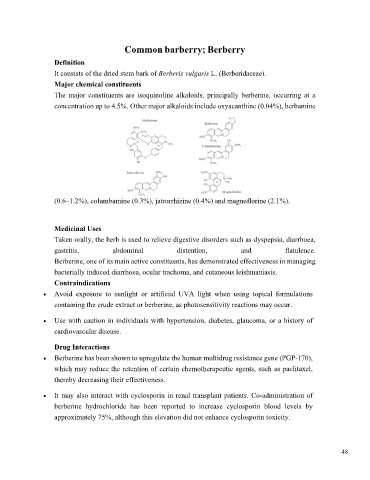
    The major constituents are isoquinoline alkaloids, principally berberine, occurring at a
    concentration up to 4.5%. Other major alkaloids include oxyacanthine (0.04%), berbamine

    (0.6–1.2%), columbamine (0.3%), jatrorrhizine (0.4%) and magnoflorine (2.1%).

    Medicinal Uses
    Taken orally, the herb is used to relieve digestive disorders such as dyspepsia, diarrhoea,
    gastritis, abdominal distention, and flatulence.
    Berberine, one of its main active constituents, has demonstrated effectiveness in managing
    bacterially induced diarrhoea, ocular trachoma, and cutaneous leishmaniasis.
    Contraindications
• Avoid exposure to sunlight or artificial UVA light when using topical formulations
    containing the crude extract or berberine, as photosensitivity reactions may occur.
• Use with caution in individuals with hypertension, diabetes, glaucoma, or a history of
    cardiovascular disease.
    Drug Interactions
• Berberine has been shown to upregulate the human multidrug resistance gene (PGP-170),
    which may reduce the retention of certain chemotherapeutic agents, such as paclitaxel,
    thereby decreasing their effectiveness.
• It may also interact with cyclosporin in renal transplant patients. Co-administration of
    berberine hydrochloride has been reported to increase cyclosporin blood levels by
    approximately 75%, although this elevation did not enhance cyclosporin toxicity.

                                                                                                                                       48

