


Page 52 - phytotherapy_ EBOOK_2025
P. 52
Gentian

Definition
It consists of the dried roots and rhizomes of Gentiana lutea L. (Gentianaceae).
Chemical assays
High-performance liquid chromatography for the presence of gentiopicroside and
amarogentin.
Chemical constituents
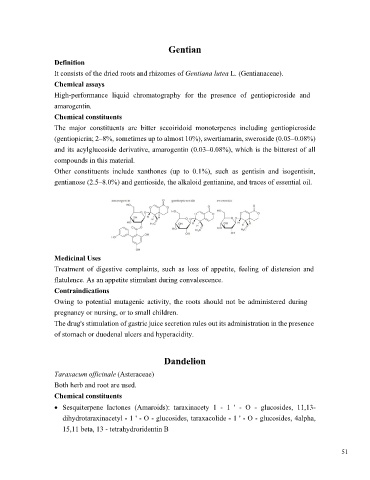
The major constituents are bitter secoiridoid monoterpenes including gentiopicroside
(gentiopicrin; 2–8%, sometimes up to almost 10%), swertiamarin, sweroside (0.05–0.08%)
and its acylglucoside derivative, amarogentin (0.03–0.08%), which is the bitterest of all
compounds in this material.
Other constituents include xanthones (up to 0.1%), such as gentisin and isogentisin,
gentianose (2.5–8.0%) and gentioside, the alkaloid gentianine, and traces of essential oil.

Medicinal Uses
Treatment of digestive complaints, such as loss of appetite, feeling of distension and
flatulence. As an appetite stimulant during convalescence.
Contraindications
Owing to potential mutagenic activity, the roots should not be administered during
pregnancy or nursing, or to small children.
The drug's stimulation of gastric juice secretion rules out its administration in the presence
of stomach or duodenal ulcers and hyperacidity.

                                  Dandelion

Taraxacum officinale (Asteraceae)
Both herb and root are used.
Chemical constituents
• Sesquiterpene lactones (Amaroids): taraxinacety 1 - 1 ' - O - glucosides, 11,13-

   dihydrotaraxinacetyl - 1 ' - O - glucosides, taraxacolide - 1 ' - O - glucosides, 4alpha,
   15,11 beta, 13 - tetrahydroridentin B

                                                                                                51

