


Page 165 - Towards A Sustainable Future , Phase 3 2025, E-Book_Neat
P. 165
This  disposal  process  is  conducted  once  a  week,  using  two  2)  The  potential  elimination  or  reduction  of  water  used  to
            bags of 20 litres each, amounting to 40 litres of water a week  soak the burnt charcoal ash for cooling purposes.
            used for soaking and subsequent disposal. This would amount
            to a total of 160 litres or 0.16m3 of water disposed of a month.  Charcoal's cleaning abilities will be further discussed in the
                                                                 next section.
            Good Environmental Practices                         Eco-solution
            Initially,  the  team  explored  the  possibility  of  heat  transfer,  Literature Review for Eco-Solution
            repurposing  the  heat  created  by  burning  the  charcoal  to  Activated carbon is a rough, poorly organised type of graphite,
            defrost the frozen meat or optimise the combustion technique.  sometimes referred to as activated charcoal. Its pores range
            However, this infringed on the company's requirement not to  widely in size, from visible cracks and fissures to molecular
            make any changes to their cooking processes.         dimensions.  Activated  charcoal  contains  small,  low-volume
                                                                 pores  that  increase  the  surface  area  available  for  chemical
            With  health  and  environmental  concerns  pertaining  to  the  processes  like  adsorption.  Due  to  its  large  surface  area,
            constant  burning  of  the  big  log  charcoal,  one  exemplary  activated  charcoal  is  widely  used  for  several  applications,
            method  that  can  be  considered  without  compromising  on  such as removing water and air pollutants [3], which makes
            the usage of Lohko charcoal is the implementation of quality  it a very effective cleaning agent. Studies have shown that,
            standards  and  production  requirements.  However,  when  before activation, charcoal has a specific surface area of 2.0
            queried, Peng Guan explained that their Lohko charcoal was  to 5.0m2g-1, which increases to 1000 m2g-1 upon activation
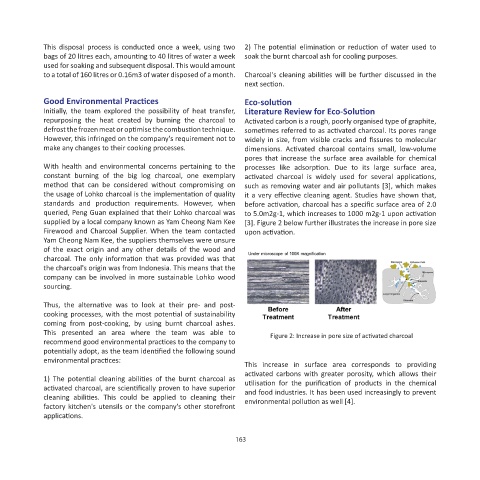
            supplied by a local company known as Yam Cheong Nam Kee  [3]. Figure 2 below further illustrates the increase in pore size
            Firewood  and  Charcoal  Supplier.  When  the  team  contacted  upon activation.
            Yam Cheong Nam Kee, the suppliers themselves were unsure
            of  the  exact  origin  and  any  other  details  of  the  wood  and
            charcoal.  The  only  information  that  was  provided  was  that
            the charcoal's origin was from Indonesia. This means that the
            company  can  be  involved  in  more  sustainable  Lohko  wood
            sourcing.

            Thus,  the  alternative  was  to  look  at  their  pre-  and  post-
            cooking processes, with the most potential of sustainability
            coming  from  post-cooking,  by  using  burnt  charcoal  ashes.
            This  presented  an  area  where  the  team  was  able  to   Figure 2: Increase in pore size of activated charcoal
            recommend good environmental practices to the company to
            potentially adopt, as the team identified the following sound
            environmental practices:
                                                                 This  increase  in  surface  area  corresponds  to  providing
                                                                 activated  carbons  with  greater  porosity,  which  allows  their
            1)  The  potential  cleaning  abilities  of  the  burnt  charcoal  as   utilisation  for  the  purification  of  products  in  the  chemical
            activated charcoal, are scientifically proven to have superior   and food industries. It has been used increasingly to prevent
            cleaning  abilities.  This  could  be  applied  to  cleaning  their   environmental pollution as well [4].
            factory kitchen's utensils or the company's other storefront
            applications.


                                                              163

