


Page 166 - Towards A Sustainable Future , Phase 3 2025, E-Book_Neat
P. 166
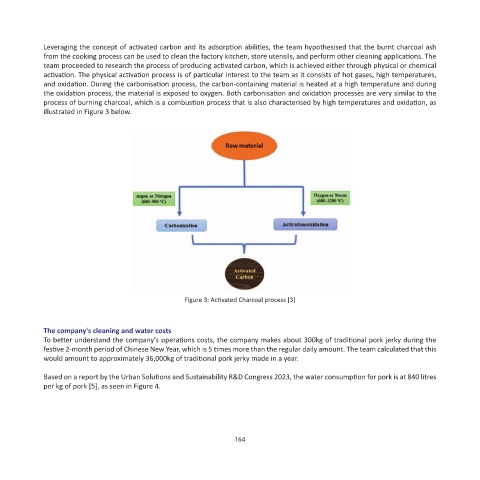
Leveraging the concept of activated carbon and its adsorption abilities, the team hypothesised that the burnt charcoal ash
            from the cooking process can be used to clean the factory kitchen, store utensils, and perform other cleaning applications. The
            team proceeded to research the process of producing activated carbon, which is achieved either through physical or chemical
            activation. The physical activation process is of particular interest to the team as it consists of hot gases, high temperatures,
            and oxidation. During the carbonisation process, the carbon-containing material is heated at a high temperature and during
            the oxidation process, the material is exposed to oxygen. Both carbonisation and oxidation processes are very similar to the
            process of burning charcoal, which is a combustion process that is also characterised by high temperatures and oxidation, as
            illustrated in Figure 3 below.


                                                 Figure 3: Activated Charcoal process [3]


            The company's cleaning and water costs
            To better understand the company's operations costs, the company makes about 300kg of traditional pork jerky during the
            festive 2-month period of Chinese New Year, which is 5 times more than the regular daily amount. The team calculated that this
            would amount to approximately 36,000kg of traditional pork jerky made in a year.

            Based on a report by the Urban Solutions and Sustainability R&D Congress 2023, the water consumption for pork is at 840 litres
            per kg of pork [5], as seen in Figure 4.


                                                              164

